Moisture Meter Accuracy
Moisture meters aren't perfectly accurate, and wood moisture content can also vary within a piece. October 25, 2006
Question
I am in the market for a moisture meter to measure lumber I am drying. I have read many forums and reviews, and have talked to the local woodworking stores. I have yet to find good information that is not contradictory. I do not want to spend a lot of money for something I don't need, but I don't want to waste money on a piece of junk. Does anyone have a good recommendation for a moisture meter, preferably under $200?
Forum Responses
(Sawing and Drying Forum)
From contributor D:
If you dry lumber, you should buy a moisture meter that reads up to 60% or more. If you only handle lumber that has been dried, then a cheaper meter works for you. Much is made of the fact that moisture meters are not accurate over 30% because of free water, but they do give you a decent range and work pretty well. Delmhorst, Lingnomat and Gann are the most established and reliable.
Pin meters and pinless meters are about equal in accuracy and Wagner is the best known in pinless. Pin meters generally are handier but you should buy one with a ram-in electrode and not one with just two thumbtack style pins on the side. I feel the pinless meter should be the second meter you buy.
From contributor F:
Depending on your location, you may want a meter that reads below 6%! 4's and 5's happen in the southwest USA desert.
From contributor T:
We use pinless meters in our operation. Both pinless and pin meters have their places, but for us, pinless is more practical. We like to be able to run it along the whole board to check consistency. Also, it doesn't leave holes in the wood. They are very pricey, though! We haven't found any difference in accuracy between the two.
From the original questioner:
Thanks for the responses. Is there a particular model anyone recommends?
From contributor N:
Just remember that meter readings are an indicator and not the absolute truth. This has been stated repeatedly by some people. The picture shows a board I dried last week. This was flatsawn from a red oak that fell in a friend's backyard. I discovered that it had a streak that read wet with the Wagner. It read 25+ at one spot, but if I moved 4" sideways, it read 9%. I stuck the exact same spots with the Delmhorst and got 10% and 5%. It was 22" wide and I didn't cut it to see what was really going on. And I found the piece that was sawn next to this piece and it was the same.
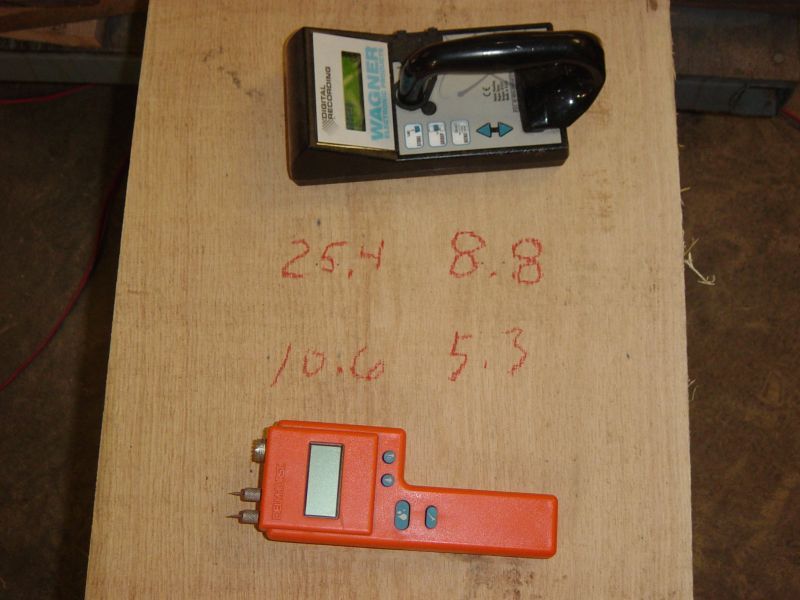
Click here for full size image
From the original questioner:
Thanks for the response. So are you saying that pinless meters are inaccurate and I should get a pin meter? I am leaning toward the Delmhorst J-2000, like you have. Would you recommend that meter?
From contributor N:
I'm saying that either type can be inaccurate. On the other hand, I've seen them read very close to baked samples. As others have said, the pinless type is nice for stepping (don't slide) along a board or pack and getting multiple readings. The pin-type is nice when you want to know the MC at different levels from the surface. I would recommend the J-2000. It has a lot of species settings, compensation for different temperatures, it's more rugged than it looks and Delmhorst is good when thinks don't go right.
From contributor N:
I was just unloading my kiln and came across the board that was in the previous picture. I forgot that I threw it in with a green load to "rebake." Look at the readings now. Seems that the meters agreed that it was wet but not on how wet.
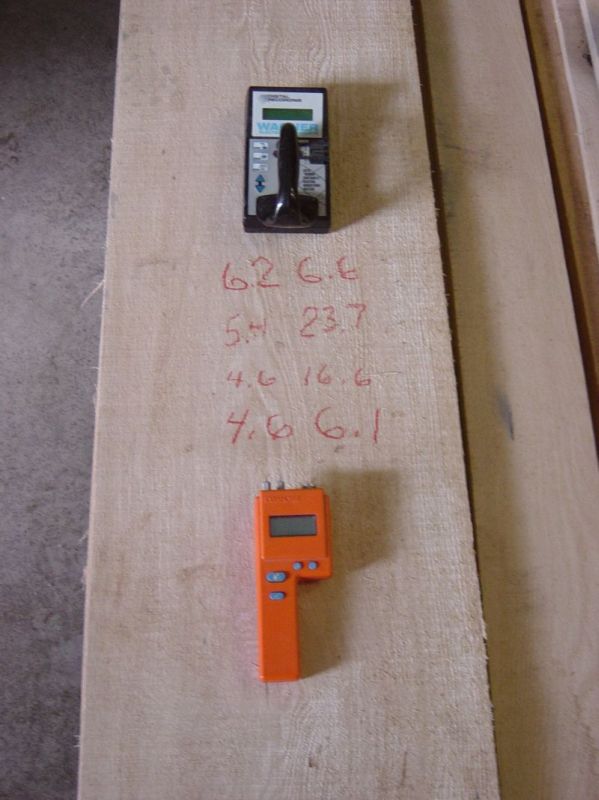
Click here for full size image
Just noticed that this was the adjacent board which happened to be laying on it's flip side.
This is the other board after being "rebaked." The meters agree that the wood is dry but they don't agree on how dry.

Click here for full size image
From Professor Gene Wengert, forum technical advisor:
Did you read the article in the archives about meters? (See link.) I believe that you cannot get a good meter under $200 that will work for kiln-dried or air-dried lumber. I also believe that you cannot use a meter to dry lumber; there is too much uncertainty. Rather, it is useful only after air-drying or kiln-drying is completed. Even then, as stated and as you will read in the article, they only estimate the MC. At low MCs, the estimates are very good, especially if you make appropriate temperature and species corrections.
Related article: Electric Moisture Meters
From contributor N:
Hi Gene, I don't know that I ever saw such an extreme wet pocket so close to dry wood. I have been wondering if that oak was beginning to develop a bacterial infection. What would you guess?
From Professor Gene Wengert, forum technical advisor:
Wet pockets are rare and do not happen normally. So it is likely that we do indeed have a bacterial infection or possibly (maybe not in this case) an injury to the tree. Mineral streaks can also cause some problems.
From the original questioner:
Gene, I have read the article, which is very good and informative. The $200 price range came from one of your earlier forum responses. I am just having difficulties determining which is the best meter as far as bang for buck and overall quality. I think I am going to purchase the Delmhorst J-2000. I found it for $199 on line. However, I rely on you veterans for recommendations. I have found the information on WOODWEB's forums of extreme value that can not be found anywhere else, especially with all of the manufacturer's propaganda.
