Preventing Hinge Attachment Failure in Commercial Cabinet Doors
Was it an ineffective fastening method, a weakness in the door material, or both? Cabinetmakers troubleshoot. March 9, 2008
Question
I was asked to remedy a bunch of commercial doors for an office building. On most of the doors the hinges ripped out of the PB, taking a large chunk with them so new doors will have to be made. Obviously, in a commercial setting they will get abused, but does anyone have tricks to prevent this from happening again to the new ones?
Forum Responses
(Cabinetmaking Forum)
From contributor B:
I wonder how big the doors are. But in general, consider using more hinges; make sure there are pilot holes of the right size. Is it possible to use bigger screws? Are the old hinges 90 or 100 degree opening? People tend to rip those off when they try to open the doors past the stopping point. Hinges with bigger angles won't do that as easily.
From contributor R:
Look at using institutional hinges that open all the way.
From contributor D:
Sounds to me like the doors were made poorly. Any good commercial grade door would not be melamine. It would be a balanced p-lam/particleboard panel. The hinges would be the press in dowel type. This type of door does not break easily.
From the original questioner:
Thanks for the responses. The existing hinges were 90 degree, so it makes sense why top and bottom hinges tore out from overextending. I was under the impression melamine was industry standard for commercial application. I'll suggest complete door restoration throughout to eliminate future problems.
From contributor B:
Contributor D, how would that solve the problem of screw tear-out, since they had pb core in the first place? Certainly that's a better door, but the expense! As far as I know, melamine doors are very widely used. Sorry to be disagreeable.
From contributor V:
As has been noted, folks were probably trying to open the doors more than the 90 degree hinges allowed. Using hinges that open 120-125 degrees makes a cabinet much more accessible and are much less likely to be put under undue stress. How were the hinges cups mounted? I've stuck with 3/4" screw mounting because I trust it. I've done pullout tests with plastic dowels and they just don't have the holding power of screws.
From the original questioner:
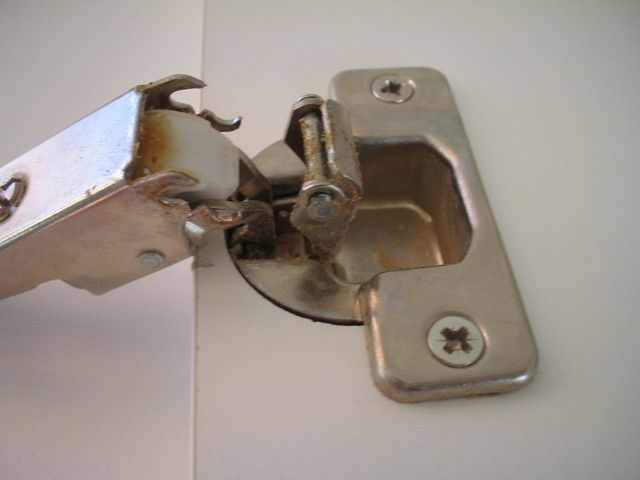
The hinge cups were mounted with plastic dowels. On most of the doors a chunk of the PB surrounding the cup sheered off with the dowels still intact.
From contributor V:
I'm not sure if you're saying that the dowels pulled out of the door, or that the screws pulled out of the dowels. I was expecting the former. After testing a dowel mounted hinge to the failure point, I'm inclined to trust them (at least the
Blum's).
Click here for higher quality, full size image
