Properly Drying Oak for Use in a Porch Swing
Thoughts on air drying, kiln drying, and conditioning for oak intended to be used in outdoor versus indoor conditions. January 11, 2007
Question
I ordered a semi load of white oak to build porch swings. The mill told us they had air dried the oak for several months prior to taking it to the kiln. Now I have a wood salesman for another company telling me that there is a good chance it will warp because white oak is extremely hard to dry and has to be rehumidified after coming out of the kiln. I don't know who to believe because we have never dealt with white oak or buying from the mill.
Forum Responses
(Sawing and Drying Forum)
From contributor Z:
What the wood salesman is describing is called conditioning, relieves drying stress. What makes you think the kiln folks did not condition the white oak lumber(?)
From the original questioner:
I don't know yet, but I will be calling them tomorrow to see if they are doing it. Thanks so much for the reply. Is it a standard practice to do that with oak?
From contributor L:
It is not too difficult to do a stress test and see if the lumber has stress. There is information available in the Knowledge Base on how to do this test. All you need is a band saw.
From contributor D:
I think there is some confusion here. If you are building porch swings, you want a relatively high moisture content. Kiln dried lumber is supposed to have a moisture content low enough for indoor use. If you use air dried lumber indoors, it may dry more and that may result in movement of the wood. If you use kiln dried outdoors, it may pick up moisture and that may result in movement of the wood. Conditioning replaces moisture in the outside of the wood only. Conventional kilns make the outside too dry while making the inside dry enough. This leaves stress because of the uneven shrinkage and those stresses can cause wood to move when it is machined.
From the original questioner:
What would be an ideal MC for white oak being used for porch swings? I have always used cedar, so this is all new to me. Thanks to everyone for the help.
From contributor L:
It is still a good idea to use lumber in the range of 6-8%. If the swings are outdoors in most of the country, they will generally pick up moisture to 10-12% and that will just make the joints tighter. But some may go to drier climates and if you make them with wetter wood that then shrinks, you might have a problem. And not all porch swings are used outdoors. Some are used in enclosed porches that can get warm and dry. Without knowing any more how you make them and where they are used, I would think 6-8% is the way to go.
From contributor M:
All material coming from a conventional kiln is rehumidified. This step is also know as equalizing. Most places air dry their material before it is placed in the kiln. This is to get the moisture content down to lessen the time in the kiln. Here again, this is a common practice used at most large operations.
I am not sure what the lumber salesman is trying to do, but everything you have stated that your supplier is doing is common practice today. A good rule of thumb is if the final product will be used outside, then air dried material is fine; if the product will go into a conditioned space (indoors), then the material should be dried to 6-8% MC. You can use the 6-8% material for an outdoor product, but the material will regain moisture to 12%.
From contributor B:
A couple points for clarification:
- The "equalization" step of kiln drying in not meant to intentionally add moisture to wood. Kiln temperature and EMC (RH) conditions are set such that the driest boards stop drying while the wetter ones in the kiln keep drying to target MC. I suppose it is possible that there might be some drier boards in the load than your samples, which might end up gaining some moisture, but that is not the specific point. The point is that the MC of the wood of boards in the kiln would have "equalized."
- The "conditioning" step is not specifically meant to add moisture to a too dry shell. The rapid addition of moisture to the shell at the end of drying is meant to cause swelling of that shell, which relieves the internal stress in lumber, which develops with shrinkage while drying. The moisture gain in the shell of hot wood from conditioning typically evaporates pretty quickly upon removal from the kiln.
- Wood which has been dried more slowly and under milder conditions typically develops less shrinkage stress, and therefore requires less conditioning to relieve those stresses (and if the final product application does not involve ripping, resawing or asymmetrical machining, stress relief conditioning may not be necessary).
- Even for wood to be used for such outdoor uses as porch swings, kiln drying is good. Consequences from moisture gain are typically less problematic than from moisture loss.
From Professor Gene Wengert, forum technical advisor:
I would hesitate to use air dried oak due to poor control of insects, especially the powderpost beetle. Further, air dried moisture contents can vary quite a bit even within one pile. Kiln dried lumber, if done properly, will have only a small MC variation.
From contributor D:
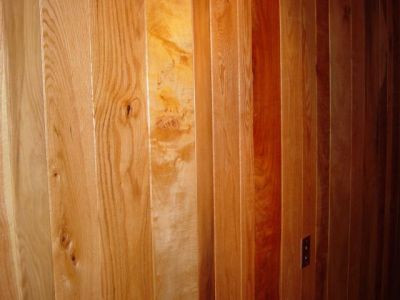
Gene is quite right about the bugs, but I don't think people realize the potential for problems with kiln dried wood used in an area with a higher EMC. I love the look of T&G V-groove paneling made with low grade, mixed species. I have it everywhere. But one spot was a problem. Acclimate first.
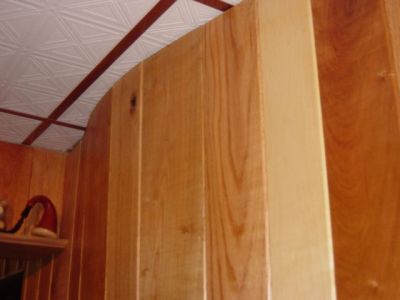
An adjacent wall with no problem.
From Professor Gene Wengert, forum technical advisor:
Contributor D's comments on acclimation are indeed correct. Make sure that your swing is not subject to a failure if the MC increases and the pieces swell a bit - in thickness and width.

