Today's
Sponsors:


AWFS

AXYZ International

B.H. Davis Company

Bailey's Inc.

Baker Products

Barn Door Lumber

BC Wood Specialties Group

Beaver Tools

Benz Incorporated

Best Cabinets

Better Vacuum Cups

Biesse America

Biewer Lumber

Black Bros. Co.

Brown Wood Products Co.

Brunner Hildebrand Lumber Dry Kiln Co.

Byrd Tool

C.R. Onsrud

Cab Parts

Cabinet Door Service Co.

Cabinet Pro

CabinetCRUNCHER Cutlist & 3D Cabinet Design Software

Cabinetmakers Association

CabinetNow.com

CADCode

Cag Lumber

Cantek America

Carolina Machinery Sales

Carter Products

Casadei Busellato

Cascade Metal Designs LLC

Casewood

Castle

Catskill Timber Industries

Cefla North America

2Sand.com

3M Corporation

A O M Spray Equipment

Abrasive Resource

Accu-Router, Inc.

AceCo Precision Wood Tooling

Advanced Architectural Grilles

Air Handling Systems

Airtight Clamps

Alan McIlvain Company

Algoma Lumber Co.

All Star Adhesives

Alliance Knife Grinding & Moulder Service

Alliance Millsoft

Allied Machinery Inc.

AllRout

Amana Tool

American Fabric Filter Co.

American Institute of Building Design

American National Woodworking Knife

American Rotary Converters

Anchor Hardwoods of the Carolinas

Antique Beams and Boards

Antique Building Materials

Anver Corporation

Apollo Sprayers Inc.

ArtCam

ATEMAG

Auton Motorized Systems


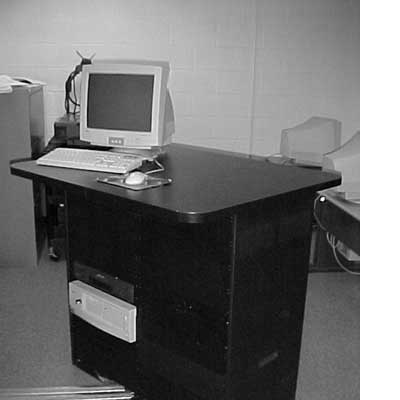
Radius Corners for a Work-Surface Cabinet Top

      The example shown could be done with T-mould, thick edgebanding, or a thermoformed panel material. June 10, 2006

Question
Can anyone direct me toward a product or technique that will allow me to create the nice radial corners shown below? The laminate material appears to be of a thickness that allows a large radius on the horizontal edge as well.

Forum Responses
(Laminate and Solid Surfacing Forum)
From contributor A:
You should be able to round your corners using a straight bearing bit on a hand router, with a template. Simply clamp your piece to the template, and cut the corner while following the template with the bearing.


From the original questioner:
Thanks, but my question is directed toward the laminate material that will allow such a corner and not show the typical color-line at the joint.


From contributor D:
What you are looking at is T-mould, which is available from Charter Industries, SFR, Outwater, and many other suppliers. After your top is laminated, run a slotter around the edge. There is a barb on the inside of the T-mould that you drive into the slot with an air hammer or a mallet.


From contributor M:
I would suggest using a color core or soli-core laminate. The color goes all the way through.


From contributor A:
It's hard to tell, but it is also possible that this part is edgebanded with a 2 or 3mm edgeband, or it may be thermoformed vinyl off of a membrane press.


From contributor D:
We produce thousands of worksurfaces each year, and this could be one of ours. The edge is T-mould. Color-through laminate is brittle and will not make the radius, even if heated. If this top used a thermoformed membrane, the edge would be the same color as the deck. If the edge were 3mm edgeband, it would be twice the cost of T-mould. The only reason to use 3mm edgeband is if you corners without a radius.


From contributor A:
The edge looks the same color as the surface to me. We do hundreds of surfaces with radius 2mm edgeband that is a custom match to our board laminate. Our customers prefer the seam over t-mold. I would agree that t-mold is easier to do though.


From contributor B:
Try using a hair dryer or heat gun (not too close) to warm up the laminate. It will bend around some pretty tight radii. Make a sample run on a radius smaller than the one you plan to cover. This will let you know if it will work for you.



Would you like to add information to this article?
Interested in writing or submitting an article?
Have a question about this article?


Have you reviewed the related Knowledge Base areas below?
  • KnowledgeBase: Knowledge Base

  • KnowledgeBase: Laminates and Solid Surfacing

  • KnowledgeBase: Laminates & Solid Surfacing: Fabrication Techniques


    Would you like to add information to this article? ... Click Here

    If you have a question regarding a Knowledge Base article, your best chance at uncovering an answer is to search the entire Knowledge Base for related articles or to post your question at the appropriate WOODWEB Forum. Before posting your message, be sure to
    review our Forum Guidelines.

    Questions entered in the Knowledge Base Article comment form will not generate responses! A list of WOODWEB Forums can be found at WOODWEB's Site Map.

    When you post your question at the Forum, be sure to include references to the Knowledge Base article that inspired your question. The more information you provide with your question, the better your chances are of receiving responses.

    Return to beginning of article.


    Refer a Friend || Read This Important Information || Site Map || Privacy Policy || Site User Agreement

    Letters, questions or comments? E-Mail us and let us know what you think. Be sure to review our Frequently Asked Questions page.

    Contact us to discuss advertising or to report problems with this site.

    To report a problem, send an e-mail to our Webmaster

    Copyright © 1996-2012 - WOODWEB ® Inc.
    All rights reserved. No part of this publication may be reproduced in any manner without permission of the Editor.
    Review WOODWEB's Copyright Policy.

    The editors, writers, and staff at WOODWEB try to promote safe practices. What is safe for one woodworker under certain conditions may not be safe for others in different circumstances. Readers should undertake the use of materials and methods discussed at WOODWEB after considerate evaluation, and at their own risk.

    WOODWEB, Inc.
    335 Bedell Road
    Montrose, PA 18801

    Contact WOODWEB


  •   Home » Knowledge Base » Knowledge Base Article