Home » Knowledge Base » Knowledge Base Article What's New  |  Site Map 


Today's
Sponsors:


Sandman Products

Saw Trax Mfg.

Sawmill and Woodlot Magazine

Schmalz, Inc.

Schultz Forming Products

Scientific Dust Collectors

SCM Group USA, Inc.

SCM Group

SCM

SDN Contracting

Seagrave Coatings Corporation

Sears Trostel Lumber Co.

Shade Dri

Sherburne Machine Development

Shomaker Lumber Company

ShopBot

SII Dry Kilns

Silvaris

Simantech

SIS Machinery

Nebraska Tool

NEMI

New England Kiln Drying Association

Newman Whitney

Norment and Lambert

North Pacific Lumber

Northtech Machinery

NPO BARS

Nydree Flooring

Nyle Dry Kiln Systems

O'Shea Lumber Company

Old Mississippi Brick and Heart Pine Company

OMGA, Inc.

Omnitech Systems

Onsrud Cutter

Opti-Sand

Original Saw Company

Osolnik Machinery & Supplies

Paul Saws and Systems

People Logic Software Corp.

Peter Meier Inc.

Pinske Edge

Pioneer Lumber Company

Planit Solutions Inc.

plastiMACH

Plogic Solutions Ltd.

Pond Cove Paint

Porter-Cable

Precision Drive Systems

Precision Saw Sharpeners

Premium Specialty Hardwoods

Pricecutter.com

Prime Estimating and Software Services, LLC

Pro.Woodworker.com

Professional Hardware & Supply Co.

Q1 Machinery

Quality VAKuum Products, Inc.

Quick Machinery Company

Quickscrews International Corporation

QuickScribe

QuickWood

QuikDrawers

Quis Machinery

R&R Drummond, Inc.

R.A.W.

R.D. Billhofer Company

Rangate

Rawles-Aden Lumber Corp.

RazorGage

Reliance Building Products

Restoration Specialists

Rex Lumber Company

Riethmiller Lumber

Ritter Manufacturing Inc.

Rockler Woodworking and Hardware

Roger Shaw and Associates

Rose Machinery

Routech

Royce Ayr Cutting Tools

RT Machine Co.

Safe Passage Consulting

Safety Speed Cut

Sand-Rite Manufacturing


WOODWEB DISCLAIMS any and all RESPONSIBILITY and LIABILITY for the accuracy and application of the information below. Readers agree to evaluate the significance and limitations of the information provided, and accept full responsibility for the application of this information. Read More ...

Would you like to add information to this article?
Interested in writing or submitting an article?
Have a question about this article?


Red Oak or White Oak?       More info on a question that comes up often. October 12, 2007

Question
Is this red or white oak?
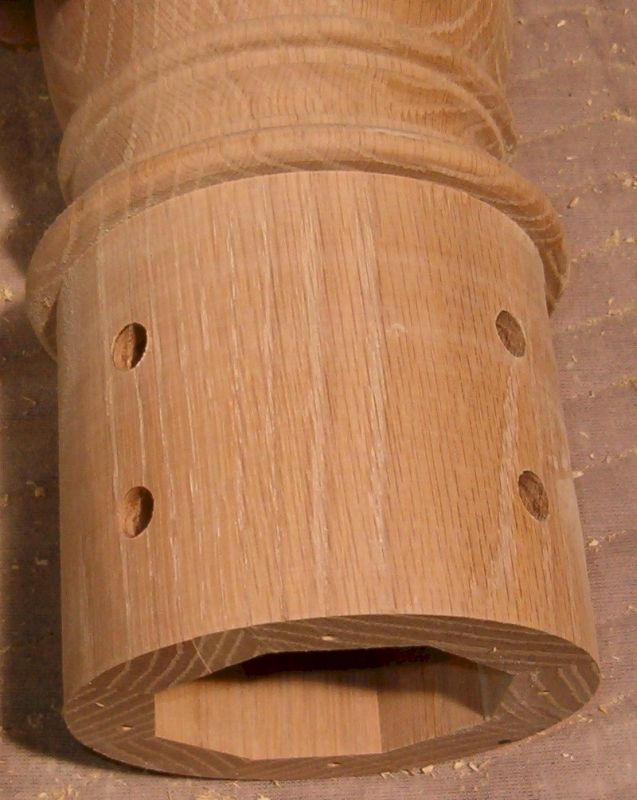

Click here for higher quality, full size image

Forum Responses
(Furniture Making Forum)
From contributor G:
Red


From contributor J:
Red


From contributor R:
Red


From contributor W:
The way to tell for sure is to look at the large pores in the end grain. If they are open (you might have to use a razor blade and make a clean slice across the end grain surface), it is a red oak. If they are totally plugged up with a white crystalline substance (tyloses), then it is white oak.


From contributor M:
I read an article one time where you stick one end in a bowl of water. If you can blow bubbles, it is red oak, and if you can't, it is white. Since it doesn't appear from the picture that you can get your mouth wrapped around this piece, my vote is for red. :)


From Professor Gene Wengert, Sawing and Drying Forum technical advisor:
The comments about white oak being plugged are not correct. There are 5 species of white oak that are open. Most notable is chestnut oak, a porous white oak. So, not all white oaks are plugged.

[In fact, I saw an ad for Jack Daniels a few years ago that had a chestnut oak on the picture and the text talked about their whiskey barrels (which cannot use chestnut oak because the barrels would leak). I wrote them a note pointing out that they had the wrong tree in the picture and they were kind enough to send me a... nice letter. Darn.]

The way to separate red oak and white oak, which is also discussed in the archives here, is to look at the rays (the short dark lines running vertically in the picture). If the rays are under 3/4", it is red oak. If the rays are often 1-1/2" long, then white. The rays in this picture look short, so it is red.

There is also a stain (sodium nitrite) which is 100% and is discussed in the archives.


From Professor Gene Wengert, Sawing and Drying Forum technical advisor:
White on top.


Click here for higher quality, full size image


From contributor J:
Thanks, Gene. Yet when looking at the picture, the "white" looks darker than the "red."


From Professor Gene Wengert, Sawing and Drying Forum technical advisor:
The two pieces I have included are not touched up, but are just as they come. So, color is a poor indicator, but the rays are certainly wider and longer in the white oak. In the original picture, I also see long and wide rays in the left side piece, so I will conclude that it is white oak, even though the color (which is not a good indicator) is somewhat reddish.


The comments below were added after this Forum discussion was archived as a Knowledge Base article (add your comment).

Comment from contributor S:
When looking at the end grain of oak, I can usually tell the difference by the pores. In red oak they will be more open and in a uniform band. In white oak they will not look as open as the red, and will be more sporadic and inconsistently oriented. Sometimes it is a bit hard to tell unless you have a piece of each next to each other.


Have you reviewed the related Knowledge Base areas below?
  • KnowledgeBase: Knowledge Base

  • KnowledgeBase: Lumber and Plywood

  • KnowledgeBase: Lumber & Plywood: Wood Identification


    Would you like to add information to this article? ... Click Here

    If you have a question regarding a Knowledge Base article, your best chance at uncovering an answer is to search the entire Knowledge Base for related articles or to post your question at the appropriate WOODWEB Forum. Before posting your message, be sure to
    review our Forum Guidelines.

    Questions entered in the Knowledge Base Article comment form will not generate responses! A list of WOODWEB Forums can be found at WOODWEB's Site Map.

    When you post your question at the Forum, be sure to include references to the Knowledge Base article that inspired your question. The more information you provide with your question, the better your chances are of receiving responses.

    Return to beginning of article.


    Refer a Friend || Read This Important Information || Site Map || Privacy Policy

    Letters, questions or comments? E-Mail us and let us know what you think. Be sure to review our Frequently Asked Questions page.

    Contact us to discuss advertising or to report problems with this site.

    To report a problem, send an e-mail to our Webmaster

    Copyright © 1996-2008 - WOODWEB ® Inc.
    All rights reserved. No part of this publication may be reproduced in any manner without permission of the Editor.
    Review WOODWEB's Copyright Policy.

    The editors, writers, and staff at WOODWEB try to promote safe practices. What is safe for one woodworker under certain conditions may not be safe for others in different circumstances. Readers should undertake the use of materials and methods discussed at WOODWEB after considerate evaluation, and at their own risk.

    WOODWEB, Inc.
    RR4 Box 265A
    Montrose, PA 18801

    Contact WOODWEB