Regrinding Corrugated Knives
Is it worth it to try re-grinding an odd-lot batch of old knives to new, useful profiles? Or alternatively, is there a used-tool market for them? July 25, 2010
Question
I purchased 700 or so knives at auction and wanted to know if it is realistic (physically and cost-wise) to regrind/reshape them to new profiles. Is there a minimum, or standard, for the amount of metal that needed for support (as installed in the cutterhead)? This seems to vary wildly for the handful of knives I have and most of the knives I purchased. I’ve only begun to sort the knives but there are a fair number of duplicates and joinery-specific type knives that I'll never use. Does anyone have any ideas for possible uses if regrinding isn't an option?
Forum Responses
(Architectural Woodworking Forum)
From the original questioner:
Here's a thought - would anyone be interested in some of these knives with the idea that they would regrind their profile into them? Some of them (I’ve put them away until I have a chance to inventory them all) seem so joinery specific, and specific to whatever piece of furniture was being made at the time, that they have zero value (other than the potential to be reground into a different profile). Do businesses/people purchase used knives with regrinding in mind?
From contributor R:
There is a formula in which most people who do what I do use to determine what width of steel to use on the initial grind. That formula leaves about 1/4" left for regrinds before it reaches the safety limit on the cutterheads. In my opinion most of the time you can't regrind it into something else without hitting the safety limit on the knife steel which goes into the cutterhead. There have been times you can do this but the odds are against you.
From the original questioner:
Obviously I jumped into this deal without fully understanding what I was getting into. Luckily, there are plenty of usable profiles. I'm just trying to figure out what to do with the duplicates and non-profiles. I've attached a picture of a couple of knives. There seems to be a noticeable difference between depth of cut and amount of corrugated steel left for the holder/cutterhead. For example, the middle knife looks like it could be ground square and still have the same number of corrugations left as the knives above it (and that knife is taller and cuts deeper, as they compare now).
If regrinding has limited options, does anyone have any ideas for reusing/reselling these knives? I don't think profiles like these would do well and i don't want to hang on to them forever.
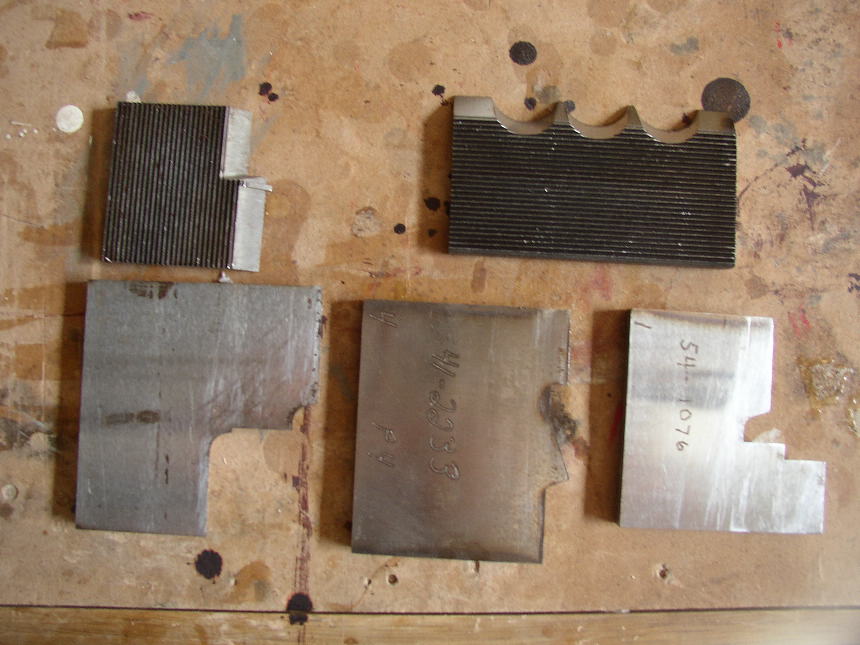
Click here for higher quality, full size image
From contributor R:
Grinding them to straight knives is a very good idea. The person that ground these did not use our formula for deciding what size steel to put things in. That’s good for you, now there are more options for you. The problem that is created when people do not use the correct steel size is it creates too big of a cutting circle and you are limited to how far you can close the bed plates, fences, hold down shoes, etc. This accounts for a lot of snipe and poor control of the work piece.
From contributor F:
Personally I think re-selling them could be a good way to go. How many straight knives are you going to need? Just because you don't have a use for many of those profiles doesn't mean someone else won't. These days you can advertise to thousands of people from the comfort of your desk with a few clicks of the mouse. I would take pictures as you go through them and maybe throw several sets at a time up for sale. If you keep the price low enough someone will likely buy them.
From contributor M:
We do our own grinding and like you have stumbled onto some deals on old knives. We would hold onto them till a new profile comes along that fits within the parameters of the old pattern and regrind them out. Obviously this could be a week or years before the right new profile comes along. Shipping steel is heavy, you want to look locally at the millwork shops and see if you can lump sum them, make a few bucks, and keep some of the good ones. One last thought, although some are good profiles, if you don't have someone who wants it, it isn't that good.
From the original questioner:
What would you consider a fair market value? Maybe priced per lineal inch? All of the tooling I had prior to this purchase came with pieces of equipment so I'm not up-to-date with these costs.
Contributor M - thanks for the suggestions and my thought has switched to trying to sell some and keep some, rather than keeping them all. I’m a one-man shop so it would be tens of years before I could possibly regrind them all.
From contributor R:
Here is the formula for deciding what width of steel to use on most moulders. Depth of profile cut + 1.375" = width of steel to use. If you fall between sizes manufactured go to the next higher size. Example, depth of cut =.375" + 1.375" = 1-3/4" width of steel.