Question
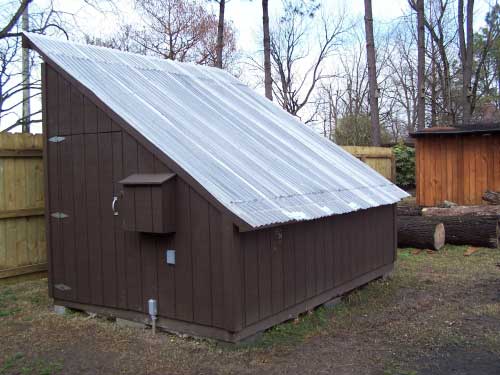
Here is my new kiln. This is my first try at this and I would appreciate a bit of a primer on how to go about drying wood with it. I have spent a lot of time on this site, as well as elsewhere researching about how to dry wood in a solar kiln and I think I have a fairly good idea of the process and the whys behind it.
I bought a Wood Mizer LT15, and I am doing this as a hobby and to perhaps sell a little wood to fellow woodworkers, so I won’t be drying or moving huge volumes of wood. My supply of logs is here and there, and since I live in southeastern Arkansas, a good part of it will be pecan. I love sycamore and I’m trying to luck out and make some spalt. I have a very nice walnut tree that we cut down recently sitting in my yard and the ends are coated with Anchor Seal, etc.
The bottom line is that I probably won’t really have a kiln full of one particular species at any time. I have repeatedly read to not mix species, but I have also read to only dry a full kiln and not small amounts of wood. You can see the conflict I will be facing. Also, because of my real job realistically I can’t be drying and weighing samples every day. I need some seat-of-the-pants advice. I already have a fair amount of cedar that has been air drying for four months, as well as some magnolia, pecan, hickory, and walnut.
My kiln, with the vents slightly open and fans running, is getting to 140+ degrees on a sunny day and it’s not even close to a hot summer yet. How hot should a solar kiln get? Today it was about 70 degrees outside and with the vents open wider (empty kiln) it got to 125 degrees and 10% humidity (60% humidity outside). The kiln is 12 feet long, 8 feet deep, north wall 8 feet tall, south wall 3 feet tall. It is well insulated, painted black, and has double glazing with polycarbonate. It is certainly tight. I have a Delmhorst pin moisture meter that goes up to 30%.
I know I need a high humidity inside for several days to not dry the wood too fast. To do that, I keep the vents closed – right? How hot is too hot? When should I cover part of my collector, and should I? It gets really hot here in southern Arkansas and I am wondering what the average temperature and RH I should shoot for inside the kiln.
Should I vary it as the drying process proceeds? Since I can’t really watch 3-5% RH drop per day, what general advice can you give me? Should I start with some of the partially dry wood I’ve already sawn? My fans are on timers and I’m not sure what time of day should they go on and off.
I know I’m not a professional and don’t have all the pieces of the puzzle, but it sure is fun to learn. However, I sure don’t want to ruin the wood I’ve already cut, or soon will cut, in the process.
Forum Responses
(Sawing and Drying Forum)
From Gene Wengert, forum technical advisor:
Nice job on the kiln. With green wood, keep the vents closed initially to avoid too rapid of drying. Each kiln performs slightly differently, so it is hard to give a fixed rule. That is why we check moisture content. If it’s air-dried, then you can open the vents slightly.
Your kiln will get quite hot with no wood in it, as the heat is used for nothing but heating the kiln. With wet wood, the wood will use the energy and the kiln will be cooler. Toward the end of drying, 40 F above outdoors would be common. The fans run when the kiln is heated up about 20 F above the morning's low, so that means maybe an hour after sunrise to an hour or so after sunset.
The science of solar is more forgiving (and slower) than the DH or conventional kilns. You can't really screw it up too bad. The beauty of the solar kiln is that it relieves the stress at night naturally. In the years I ran my solar kiln, I never had trouble with mixing wood. It was just to slow after the weather started to cool down and the hours of sunlight were reduced. Dry what you need for the winter during the summer months. You can keep it in the kiln during the winter and it will stay dry.
If you air dry first, you can get away with a lot more as far as mixing species. With my kiln, drying from around 15% down to the 8% range is very slow. To speed up the process I keep the vents almost completely closed for maximum heat.