Home » Knowledge Base » Knowledge Base Article What's New  |  Site Map 


Today's
Sponsors:


Invicta Woodworking Machines

IpeDepot.com

irsauctions.com

Italpresse

J&P Machines

J. Gibson McIlvain Company

JIT Hardware Supplies, Inc.

JMHsoftware.com

John G. Weber Co.

Joos USA Inc.

KCDw

Kerber Farms and Mill

Keystone Wood Specialties

Keytrix Data Systems

Kiln-direct.com

Kleiberit Adhesives USA, Inc.

Koch Machinery and Systems

Komo Machine, Inc.

Kreg Tool Company

Kremlin

Lacy Cypress Inc.

Laguna Tools

Lane Stanton Vance

LEUCO Tool Corporation

Lewis Lumber Products

Lobo Machinery Corp.

Loch Logging and Lumber

Logosol

Lubie Lube

Lumber Resources

MACHINEKING.com

Machines Italia - Italian Trade Commission

Macoser, Inc.

Mahros

Maine Woods Company

Mann and Parker Lumber Co.

MARTIN Woodworking Machines Corp.

Mastercam - CNC Software

Matthews Mill

Maya Positioning Equipment

Mereen-Johnson Machine Company

Merritt Woodwork

Microvellum

Mid America Protective Coatings

Mid-America Hardwoods

Middle Valley Lumber

Midwest Automation

Midwest Sandright

Mikron Woodworking Machinery

Mill Outlet

Minimax

Mirror Reflections

Mississippi Heart Pine

Miter Clamp

MLS Machinery USA, Inc.

MLS Machinery

Modern Woodworking Magazine

Moldingknives.com

Monarch Machinery

Morbidelli

Moulder Services

Moulder Techniques

Mountainside Wood Products

Multicam, Inc.

NAP Gladu

NCME

Hardware Resources

Hardwood Council

Hardwood Store of N.C. Inc.

Hasko Machines

Heidelberg Flooring

Hendrick

Her-Saf

Hermance Machine Company

High Point Grinding - Total Saw Solutions

Historical Plus Wood

Hoffmann Machine Company

Holz Her U.S. Inc.

Howard S. Twichell Co.

HSD USA

Hvalsoe Sawmill Ltd.

ICA North America

Icy Straits Lumber

IDM

Impact Search and Placement

Industrial Air Solutions

Industrial Maid

Integra Tooling

InTrading


WOODWEB DISCLAIMS any and all RESPONSIBILITY and LIABILITY for the accuracy and application of the information below. Readers agree to evaluate the significance and limitations of the information provided, and accept full responsibility for the application of this information. Read More ...

Would you like to add information to this article?
Interested in writing or submitting an article?
Have a question about this article?


"Safe Drying Rate" and a Dehumidifier Kiln       A discussion of how to apply "safe drying rate" calibrations with a home-built dehumidifying kiln. January 27, 2007

Question
I recently picked up a back issue of American Woodworker, #94 June 2002, that has a good article on constructing a simple DH kiln. I have constructed a kiln using these plans. It uses a simple humidistat to control the dehumidifier, and a remote bulb thermostat to control the heater, which is a couple of light bulbs.

Ignoring for a moment the merits of a homebrew DH kiln versus a Nyle, I was curious to see that rather than referencing the standard kiln schedules (e.g. T8-C3 or similar for hard maple), the article instead provided a table showing the "safe drying rates" (SDR) for a number of species. For 4/4 hard maple, with an initial temperature of 90F and an initial relative humidity of 81%, the SDR was given as .0061 pints per hour per board foot. So, if you have 100 bf in the kiln, every 12 hours you would extract (12 hours *100bf * .0061 SDR) = 7.3 pints of water. Basically the idea seems to be to maintain a constant temperature, and to keep lowering the humidistat to maintain the SDR until the moisture content gets to the desired level. Seems like a pretty simple way to run the kiln - once or twice a day just measure the amount of water extracted, and turn down the humidity a bit as needed.

So, with that lengthy introduction, here is my question. How do I convert from the standard kiln schedules in the USDA's "Dry Kiln Schedules for Commercial Woods" and "Drying Hardwood Lumber" to an SDR-type schedule?

I am also curious why an initial temperature of 90F would have been selected. I'd like to know for my own curiosity, as well as to be able to generate SDR schedules for other species not given in the American Woodworker article, like the 6 foot long 24" wide slabs of 8/4 madrone I got this summer. Not bragging or anything!

Forum Responses
(Sawing and Drying Forum)
From contributor D:
It is a meaningless exercise to try to convert those schedules for the kiln you built. They are based on different air flow rates, etc. There is a way to do the conversions and there is a chart published by Nyle to do it, if you want to do some academic exercise. The conversion method described in the Dry Kiln Operator's Manual is not really accurate, but it is safe. The approach described in the article where you try to keep the water leaving at a steady rate is fine. There might be a problem with that if the chamber overheats and has to be vented because some water will leave that way. Also, for that approach to work, the chamber needs to be air tight.


From Professor Gene Wengert, forum technical advisor:
I developed the SDR for lumber years ago and they are for commercial kilns using good air flow, etc. They are not convertible but are intended to fine tune the standard schedules.


From the original questioner:
Thanks for the responses. I guess I am still wondering where to get info on SDRs for other species? I have a bunch of obscure species like madrone, sycamore, different kinds of cedar, yew, etc that I would like to run through the kiln. I checked the Nyle site and the Dry Kiln Operator's Manual, but I couldn't find any info at either place. Would appreciate any tips on how to derive or locate SDR schedules for various species.


From Professor Gene Wengert, forum technical advisor:
The only Safe Drying Rates that I developed and have been printed are in "Drying Hardwood Lumber."


From contributor M:
I also recently built a version of the DH kiln featured in American Woodworker in June 2002. My kiln is 11 feet long to accommodate 8.5 red oak floor 5/4 boards. Its size requires two ceramic heaters and two heating bulbs. Conditioning is completed with a commercial steam generator and two wallpaper steamers. My first load is okay but I would be happier with less cupping and end splitting.

My question focuses on the initial relative humidity featured in the Safe Drying Rate table. With each load I did not have the initial relative humidity rate. The first load was started with 60% and this load was started with 78%. Although I can maintain the 90 degree temperature, I could not start at the recommended humidity level unless I added humidity. Should I? I am removing water about 50% below the SDR. Would adding humidity at the start, bringing the initial relative humidity rate to 87% as suggested in the table, result in better product or faster drying?


From contributor D:
Don't add humidity at the beginning - ever. That is the safe answer. There are a number of reasons for that that Gene has probably covered before. You can probably never achieve the SDR ratings because the drying rate is related to temperature and you are running a pretty low temperature. For example, at the same RH, it takes twice as long to dry at 90 degrees as it does at 120 degrees. If you try to speed it up by lowering the humidity, you get checking.

Also, you can't really control well by measuring the collected water because some of the water leaks out with vented or leaking air. I know your kiln is absolutely tight and perfectly sealed, but it has to vent some or it would overheat. If it isn't overheating, it is leaking.

You won't ever have the fastest kiln in town, but it can still work. I don't remember how the air flow was arranged in the kiln in the magazine, but it sounds like that could be a problem for you.


From the original questioner:
Glad to hear that your ceramic heaters are working well for you. I have trouble getting the temp high enough at the start of the cycle, and was thinking of doing the same. I will pick up a couple and add them.

At the end of the cycle I have the opposite problem. As the MC drops and I crank the DH on more and more, the temp tends to rise up too high just from the heat the DH throws off, even though the light bulb heaters are not on at that point. I'm thinking I could vent it manually, but with the RH so high externally I am not sure if that is the right thing to do.

I guess I am thinking that while I am seeing the wood's MC and the kiln's RH drop smoothly, the fact that the temperature jumps around a bit may mean that the drying rates are hard to control, hence my loss of horse chestnut.

Anyway, I included my log of a load I did in Nov '06 for everyone's amusement. Temps are in Celsius (20C = 70F, 40C = 105F). I know mixed loads are taboo, but this one worked well, other than the horse chestnut. The column on the right I added part way through is the kiln's internal RH. I modified one of the Radio Shack combo units so it could measure the RH remotely as well as the temp.
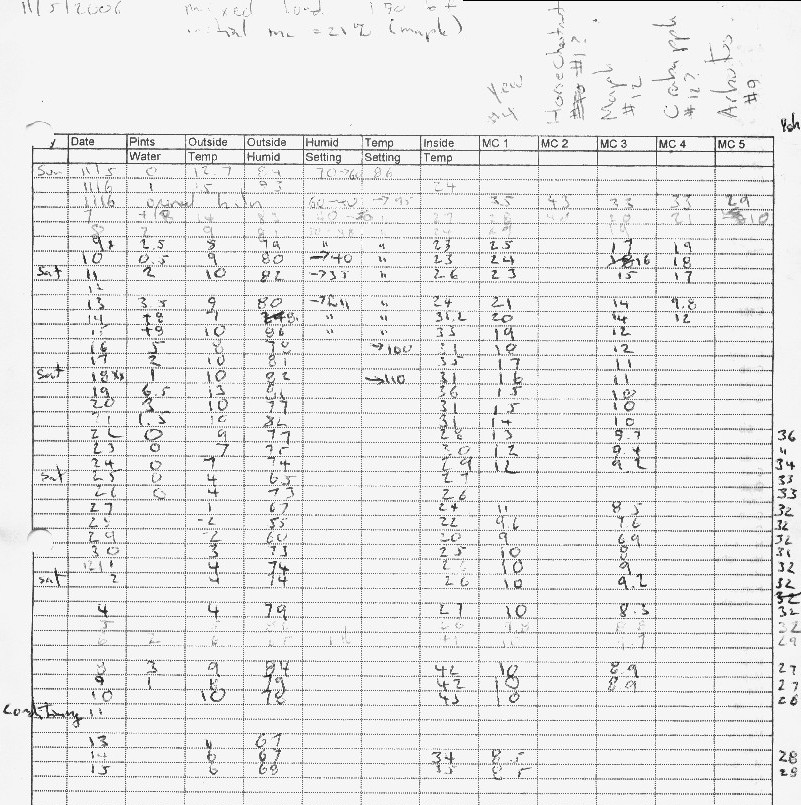

Click here for higher quality, full size image

Have you reviewed the related Knowledge Base areas below?
  • KnowledgeBase: Knowledge Base

  • KnowledgeBase: Primary Processing

  • KnowledgeBase: Primary Processing: Kiln Construction

  • KnowledgeBase: Primary Processing: Kiln Operation


    Would you like to add information to this article? ... Click Here

    If you have a question regarding a Knowledge Base article, your best chance at uncovering an answer is to search the entire Knowledge Base for related articles or to post your question at the appropriate WOODWEB Forum. Before posting your message, be sure to
    review our Forum Guidelines.

    Questions entered in the Knowledge Base Article comment form will not generate responses! A list of WOODWEB Forums can be found at WOODWEB's Site Map.

    When you post your question at the Forum, be sure to include references to the Knowledge Base article that inspired your question. The more information you provide with your question, the better your chances are of receiving responses.

    Return to beginning of article.


    Refer a Friend || Read This Important Information || Site Map || Privacy Policy

    Letters, questions or comments? E-Mail us and let us know what you think. Be sure to review our Frequently Asked Questions page.

    Contact us to discuss advertising or to report problems with this site.

    To report a problem, send an e-mail to our Webmaster

    Copyright © 1996-2008 - WOODWEB ® Inc.
    All rights reserved. No part of this publication may be reproduced in any manner without permission of the Editor.
    Review WOODWEB's Copyright Policy.

    The editors, writers, and staff at WOODWEB try to promote safe practices. What is safe for one woodworker under certain conditions may not be safe for others in different circumstances. Readers should undertake the use of materials and methods discussed at WOODWEB after considerate evaluation, and at their own risk.

    WOODWEB, Inc.
    RR4 Box 265A
    Montrose, PA 18801

    Contact WOODWEB