Today's
Sponsors:


Limtech Industries, Inc.

Logosol

Lumber Resources

Lumber Smith

M.L. Campbell

MACHINEKING.com

MARTIN Woodworking Machines Corp.

Mastercam - CNC Software

Maxima Software

Maya Positioning Equipment

Mereen-Johnson Machine Company

Merritt Woodwork

Microvellum

Middle Valley Lumber

Mikron Woodworking Machinery

Mill Outlet

Millwork Inc.

MLS Machinery

Monarch Machinery

Monarch Metal Z Clip and Panel Clip

Moulder Techniques

Mountainside Wood Products

MultiCam Southeast

Multicam, Inc.

Nail Gun Depot

National Decon

New England Drawer

New England Kiln Drying Association

NEWCNC.com

Newman-Whitney

Nyle Dry Kiln Systems

O'Shea Lumber Company

Old Mississippi Brick and Heart Pine Company

Hoffmann Machine Company

Holz-Her US Inc.

Hot Melt Technologies

Howard S. Twichell Co.

Hvalsoe Sawmill Ltd.

ICA North America

Impact Search and Placement

Industrial Air Solutions

Integra Precision Tooling

InTrading

IpeDepot.com

irsauctions.com

Italpresse

J & G Machinery

J and B Hardwood Co.

J&P Machines

J. Gibson McIlvain Company

JMHsoftware.com

Joos USA Inc.

JusDust.com

KCD Software

Kentucky Pacific Lumber

Kerber Farms and Mill

Keystone Wood Specialties

Keytrix Data Systems

Kleiberit Adhesives USA, Inc.

Kreg Tool Company

Kremlin

Lacy Cypress Inc.

Laguna Tools

Leadermac USA

Leitz Tooling Systems

Lewis Lumber Products

Lignomat


Sawing Your Own Framing Lumber

      Proper grading is an issue, because knots may weaken the material for structural purposes. April 20, 2011

Question
I soon will have a new band sawmill with which to cut some eastern white pine, only some of which will likely yield high quality boards. My questions are: is the poorer quality knotty pine strong enough to use as construction lumber, e.g., as 2x4, 2x6's, etc.; and if rough sawn, air dried pine is used as siding, will pitch be a problem if semi-transparent stain is applied?

Forum Responses
(Sawing and Drying Forum)
From contributor P:
What you describe as low quality and knotty is what’s available at the lumberyard. Each piece of lumber has to be looked at for quality when building with it, even the store bought stuff. Sawyers who use their own lumber get more knowledge of what works. Spike knots steal more strength than round knots do. You will probably find out like I did, you get a lot of unusable and some good.


From contributor B:
As long as there are no obvious defects: shake, insects, or rot you can use the lesser grades for many things around the home. Pine furniture, timberframes, and siding are uses around my place!


From Gene Wengert, forum technical advisor:
Sap will ooze from the lumber if it is not dried (or heated) at a temperature over 150 F or so for at least 24 hours. Most finishes do not stop this sap bleeding.

Regarding the use for construction lumber, such as for a home, the knotty material may be strong enough, but most structures that are used for human occupation will require graded lumber. The grades require special knowledge and application of this knowledge to assure that the knots that are present do not weaken the piece too much. Very few states allow you to cut your own lumber and use it for construction of a home or other building without having the wood graded.
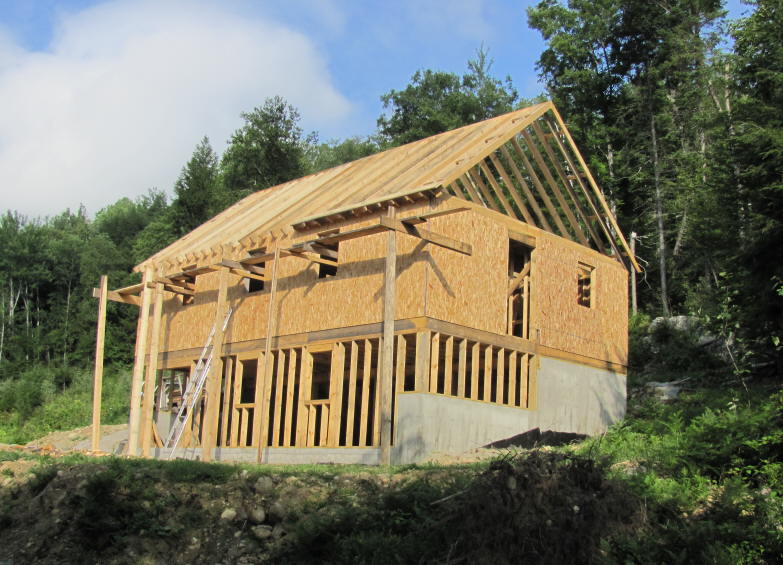


From contributor P:
I started this house in NH four weeks ago. It’s framed almost entirely out of white pine sawn from my mill.


Click here for higher quality, full size image


From the original questioner:
Impressive photo. Did you kiln dry the wood? If not, does the sap indeed ooze?


From contributor P:
I just air dried the lumber. There is pitch on some of the lumber, but not really a problem for framing.


Would you like to add information to this article?
Interested in writing or submitting an article?
Have a question about this article?


Have you reviewed the related Knowledge Base areas below?
  • KnowledgeBase: Knowledge Base

  • KnowledgeBase: Primary Processing

  • KnowledgeBase: Primary Processing: Lumber Grading

  • KnowledgeBase: Primary Processing: Sawmilling


    Would you like to add information to this article? ... Click Here

    If you have a question regarding a Knowledge Base article, your best chance at uncovering an answer is to search the entire Knowledge Base for related articles or to post your question at the appropriate WOODWEB Forum. Before posting your message, be sure to
    review our Forum Guidelines.

    Questions entered in the Knowledge Base Article comment form will not generate responses! A list of WOODWEB Forums can be found at WOODWEB's Site Map.

    When you post your question at the Forum, be sure to include references to the Knowledge Base article that inspired your question. The more information you provide with your question, the better your chances are of receiving responses.

    Return to beginning of article.


    Refer a Friend || Read This Important Information || Site Map || Privacy Policy || Site User Agreement

    Letters, questions or comments? E-Mail us and let us know what you think. Be sure to review our Frequently Asked Questions page.

    Contact us to discuss advertising or to report problems with this site.

    To report a problem, send an e-mail to our Webmaster

    Copyright © 1996-2012 - WOODWEB ® Inc.
    All rights reserved. No part of this publication may be reproduced in any manner without permission of the Editor.
    Review WOODWEB's Copyright Policy.

    The editors, writers, and staff at WOODWEB try to promote safe practices. What is safe for one woodworker under certain conditions may not be safe for others in different circumstances. Readers should undertake the use of materials and methods discussed at WOODWEB after considerate evaluation, and at their own risk.

    WOODWEB, Inc.
    335 Bedell Road
    Montrose, PA 18801

    Contact WOODWEB


  •   Home » Knowledge Base » Knowledge Base Article