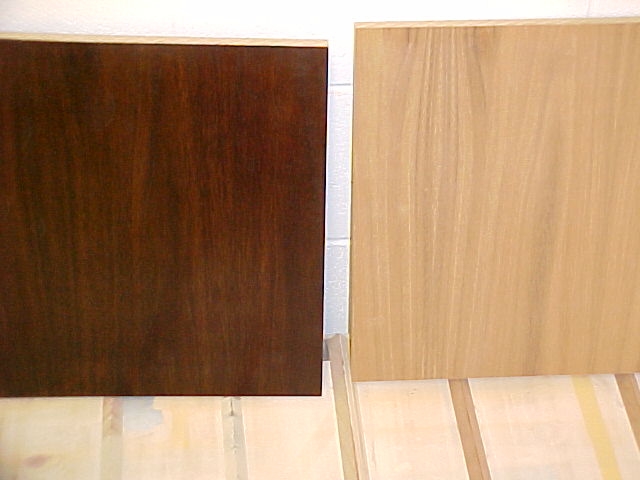
Shading and Toning Eastern White Pine
Advice on how to achieve a consistent, uniform dark color on white pine. July 17, 2008
Question
I am trying to please a client who wants a darker colored stain on some eastern white knotty pine cabinetry I am building for her. She is very particular, and she originally liked the stain color I did on a sample board, but then rejected the sample panel I made for her. She did not like how the panel looks striped, where the color changes at the glue up from board to board or where the veneer comes together at the seams. I used seal coat prior to staining to try and help with the absorption of the gel stain, but it still doesn't look consistent enough for her.
My thought next would be to try and spray toners over the stain to build up a more consistent finish, although I have never tried doing this to this degree. How many coats of toner does it typically take to even out this sort of thing? The color of the gel stain is Generals Antique Walnut, which is a pretty dark brown. I am concerned, trying to spray a toner this dark, that I will get striping in the toner.
Forum Responses
(Finishing Forum)
From contributor P:
I've had good luck using Lockwood powdered dyes on pine. Just mix with water and spray. Don't wipe. Seal coat, then topcoat. Easy and virtually no blotching. I have a sample board done with their Standard Brown Mahogany color that looks pretty walnutty. But they have a ton of different colors. Do toning after that if you need to, using multiple light coats with just a little pigment at a time. You definitely want to sneak up on the final color, rather than try to do it all in one pass. This should also help avoid striping.
From contributor D:
Sounds like you need to use a shader, not a toner. Much easier to control the color and get it darker without lap lines and muddiness, if that's a word.
From contributor L:
Pine is always difficult. Try metal dyes, then toner or just clear coat. I have seen lacquer stains that work well also.
From the original questioner:
Thanks for the replies. What is the difference in shading versus toning? I have never done this before.
From contributor C:
Toning is using a color that uniforms the surface out so nothing stands out from any other area. Shading is applying color that darkens the surface to whatever degree you desire. It usually is used to highlight the edges of the surface or to darken the entire surface as necessary. Black is used quite often, but any color darker than the overall color can be used.
From contributor R:
This has been kicked around on this site forever. I was taught that toning is spraying pigment to tone out a bad piece of wood (black streak in poplar, for example). Usually done on the raw wood. Shading is doing color adjustments after stain and sealer, either to correct color, or like contributor C said, to highlight specific areas (like a sunburst guitar effect). Mostly shading is done using dyes, but not always.
From contributor C:
Contributor R is correct as to using a pigment to even out a dark streak and blending it into its overall color surround.
The actual definition of "tone" is:
1: to assume a pleasing color quality or tint
2: to blend or harmonize in color
By this definition, though, you could also use dyes to tone in sapwood to match the overall color needed. There used to be walnut, cherry, and other readily available sap stains used for this purpose. Whether a dye or stain, the aspect of toning is to blend or harmonize the overall wood color background, be it on the bare wood or over a clear coat or other.
As to shading, its proper meaning is to shadow to whatever degree necessary, though for a long while now it's been more synonymous with darkening than edge shading alone. This can also be accomplished on the bare wood or over a coated surface. Most of my gun shading with water dyes is accomplished on the bare wood before it's sealed, and if needed, any further work is accomplished over the sealed wood. This use to be the industry standard taught in finishing up to the 60's.
From contributor D:
Toning is putting dye or pigment in your lac coat. This is good for very minor color adjustments. The way I shade, and I do this almost every day, I put about 25% lac thinner in a touch up gun, then strain quick dry pigmented stain. The best I have found is Mohawk. I have never used long drying stain, i.e. Minwax, Zar - never had a use for them. The lac thinner helps break down the pigment. Turn your air pressure up a little (you need compressed air to shade, air assisted or turbine won't work). Stay about 24" away and just spray where you want color. The whole piece or just a little spot, then spray your pre-cat, con var right on top, no waiting needed. Sometimes if I am doing heavy shading I will wait about 2-5 minutes. You can shade into corners with no lap lines, no little dots of pigment or heavy build up. Doing this takes a little practice. When I do a cherry or maple kitchen, I thin down the stain, then add the rest of the color through a shader. You can shade on raw wood, which I never do. On top of sealer or any of the topcoats. If you have ever looked at those factory made maple kitchens and wondered how they got the color so even, this is how.