Home » Knowledge Base » Knowledge Base Article What's New  |  Site Map 


Today's
Sponsors:


WMMA

Wood and Wood Products

Wood Doctor's Rx, LLC

Wood Tech Enterprises, Inc.

Wood Technology Inc

Wood-Mizer

Wood-Ply Lumber Corp.

WoodCabinetDoors.Com

Woodcraft Supply Corp.

WoodcraftPlans.com

WoodenBoat

WoodFinder

WoodJobs.com Search Consultants

Woodland Dimension Products

WoodLINKS

Woodmaster

WoodPlanet Inc.

WOODWEB

Woodworker's Supply/woodworker.com

Woodworker's Directory

Wright Timber

SK-USA

SketchList

SlipCon USA, Inc.

SoCalMachinery.com

South State Machinery

South Texas Moulding

Southeast Tool, Inc.

Specialtytools.com

SprayGunWorld.com

Stairguy Stairbuilding Videos

Stefani

Steve H. Wall Lumber Co.

Stiles Machinery

Stiles Shop Solutions

Stor-N-Fold Systems

Super Source Tooling Inc.

Supergrit Abrasives

Surface and Panel Magazine

Target Coatings

Techno CNC Routers

Template Services

Teragren

The Cayce Company

The Veneer Store

Thermwood Corporation

TigerStop

TigerwoodDecking.com

TimberKing

Timesavers Inc.

TMS Machinery Sales

Tongass Forest Enterprises

Tooling on the Web

Toolstoday.com

Touch Up Solutions LLC

Tractivity

TradeSoft

Trakware Systems Inc.

TRB Flooring Company

Tropical American Tree Farm

Tropical Hardwoods

UC Coatings Corp.

Unique Machine & Tool

University of Wisconsin

UWMO Auctions

VacDry Kilns

Vacuum Pressing Systems, Inc.

Vacuumpods.com

Vecoplan LLC

Vector Art 3D

Vectric Ltd.

Veneer Systems Inc.

Veneer Technologies Inc.

Vintage Perkins

VortexTool Co. Inc.

VyTek

W. Moore Profiles, Ltd.

W.L. Fuller

Wadkin North America

Wagner Electronic Products

WalzCraft Industries

Webb Abrasives

WEIMA America, Inc.

Weinig Group - USA

Western Dovetail

Williams and Hussey

Wisconsin Knife Works

WMIA


WOODWEB DISCLAIMS any and all RESPONSIBILITY and LIABILITY for the accuracy and application of the information below. Readers agree to evaluate the significance and limitations of the information provided, and accept full responsibility for the application of this information. Read More ...

Would you like to add information to this article?
Interested in writing or submitting an article?
Have a question about this article?


Splitting stiles with pocket screws       Suggestions are offered on how to overcome the problem. July 24, 2002

Question
I recently started using pocket screws to assemble my face frame stock. I am having a problem with the stiles splitting as I screw the rails to them. I'm using a Kreg jig and a self-drilling, flat head pocket screw. Speed that I'm driving the screw doesn't seem to be a factor, nor does wood type.

Forum Responses
Splitting frames and breaking screws have not been uncommon. S&G Specialty has designed a series of screws for pocket holes to overcome these and other problems. They have a great web site.


On most hardwoods, make sure you are using the fine thread screws. Also, use a drill with a clutch and set the clutch so it slips prior to the wood splitting. Of course, don't screw into end grain, either.


I've used the Kreg jig system for pocket holes for several years as my primary frame assembly method. I mostly use birch, white pine, maple (soft and hard), poplar and occasionally hickory and red/white oak. I order my screws from McFeely's but have used others with similar success. I used to use the fine threaded screws for hardwoods and the coarser ones for softwoods, but because I seem to have a habit of running out of one or the other, I now stock the ones that are dual purpose (hard and softwoods) for use with both species. I always prepare my screws by scraping their tips into paraffin wax (usually a large candle). I do this with every type of screw that I am going to run into hardwood if I have not provided a pilot hole (as when screwing into stiles during face frame assembly). That doesn't do much to help splitting, but it definitely helps reduce the force required and friction produced when driving screws.

You should not be having problems splitting the stiles out, except when attaching top and bottom rails to the very ends of the stiles. I use 1-3/4", 2", and 3" rails to produce my framed cabinets (depending on cabinet and rail location). First, you should try and keep your outside hole (the one that you drill in the rail, which will end up being closest to the end of the stile) as far away from the end as practical.

Here's what I do to keep from splitting the ends of stiles - drill the screw into the stile with *very* short bursts of trigger pull, allowing a short (about half a second) pause between bursts - zip, zip, zip, zip, zip, zip, zip, until the screw is fully seated. It's rare for the stile to split out using this method - try it, even though you said that it doesn't matter what speed you drive the screws, it does matter at what pace (or cadence) you drive them. It also helps to use extra heavy clamp pressure (centered right over the screw you are inserting) with the Kreg frame clamp – but the real trick is the short bursts!


Rather than flat head screws, you should be using pan head screws - then just snug them up.


Pan heads are good, except that the washer head was developed for jigs that use drill bits (Kreg), while the pan heads are for machines that use routers, such as Castle. Kreg does now have a flat bottom drill bit, but flat is a relative term and the high-speed, very flat router does prepare the hole differently. The type 17 point plus the Quickcutter flute will stop the splitting and the thread count and other features will make a difference overall.


I don't think I've ever split a stile with Kreg's washer-head fine thread screws. I have split a few rails when I went too fast.


We use the Kreg jig and never split any wood. We also use a set of vise grips with the quarter-like pads on the ends to clamp the pieces together while screwing. This does a good job getting the two pieces even and saves time in sanding.


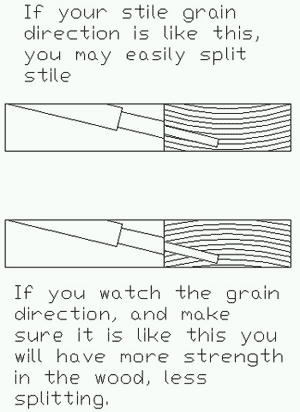
It could have to do with the grain direction on your stile. I have found that with oak, if you don't watch which way the grain cups, you have a better chance of splitting.


The comments below were added after this Forum discussion was archived as a Knowledge Base article (add your comment).

Comment from contributor A:
Try setting the depth of your jig shallower and using no more than 1 1/4" screws. I also use fine thread for hardwoods such as oak, maple, and hickory, and coarse thread for pine and the like.

Have you reviewed the related Knowledge Base areas below?
  • KnowledgeBase: Cabinetmaking

  • KnowledgeBase: Cabinetmaking: Commercial Cabinetry

  • KnowledgeBase: Cabinetmaking: Custom Cabinet Construction

  • KnowledgeBase: Cabinetmaking: Cabinet Design

  • KnowledgeBase: Cabinetmaking: General

  • KnowledgeBase: Cabinetmaking: Residential Cabinetry

  • KnowledgeBase: Cabinetmaking: Store Fixtures

  • KnowledgeBase: Woodworking Miscellaneous

  • KnowledgeBase: Woodworking Miscellaneous: Accessories

  • KnowledgeBase: Woodworking Miscellaneous: Woodworking

  • KnowledgeBase: Knowledge Base


    Would you like to add information to this article? ... Click Here

    If you have a question regarding a Knowledge Base article, your best chance at uncovering an answer is to search the entire Knowledge Base for related articles or to post your question at the appropriate WOODWEB Forum. Before posting your message, be sure to
    review our Forum Guidelines.

    Questions entered in the Knowledge Base Article comment form will not generate responses! A list of WOODWEB Forums can be found at WOODWEB's Site Map.

    When you post your question at the Forum, be sure to include references to the Knowledge Base article that inspired your question. The more information you provide with your question, the better your chances are of receiving responses.

    Return to beginning of article.


    Refer a Friend || Read This Important Information || Site Map || Privacy Policy

    Letters, questions or comments? E-Mail us and let us know what you think. Be sure to review our Frequently Asked Questions page.

    Contact us to discuss advertising or to report problems with this site.

    To report a problem, send an e-mail to our Webmaster

    Copyright © 1996-2008 - WOODWEB ® Inc.
    All rights reserved. No part of this publication may be reproduced in any manner without permission of the Editor.
    Review WOODWEB's Copyright Policy.

    The editors, writers, and staff at WOODWEB try to promote safe practices. What is safe for one woodworker under certain conditions may not be safe for others in different circumstances. Readers should undertake the use of materials and methods discussed at WOODWEB after considerate evaluation, and at their own risk.

    WOODWEB, Inc.
    RR4 Box 265A
    Montrose, PA 18801

    Contact WOODWEB