Spray Booth Safety
A discussion of spray booth requirements, with some interesting photos. October 14, 2006
Question
I mainly finish small pieces and have a makeshift spray booth. I found the design in a wood finishing magazine. I bought a 20" box fan and positioned it to blow outwards. I placed a regular air filter in front of it (which is actually the back of the fan) to collect all the overspray. I am mainly using spray cans that I buy from a finishing store. I also have two 100 watt bulks positioned over the spray booth, approximately 3 feet above the spray area. All this is positioned in a corner in the back of my garage. After reading a lot of the postings on this website, I am wondering if my spray booth set-up is dangerous.
Forum Responses
(Finishing Forum)
From contributor A:
You are sure to kill yourself and probably burn down the house. I'm a cabinetmaker and do most of my own finishes, so I'm not the ultimate authority, but here are some suggestions to improve your chance of survival.
Use non-flammable water based finishes. I know they don't build well and are not durable. But I assume you don't want to die. Get an explosion proof fan, or make sure the fan that you are using is upstream from where you are spraying - so instead of sucking air out of the booth you are blowing it in. Keep all sources of ignition (like your lights) far away from flammable environments. If that bulb blows while you’re spraying, you’re history. Usually we use explosion proof lights.
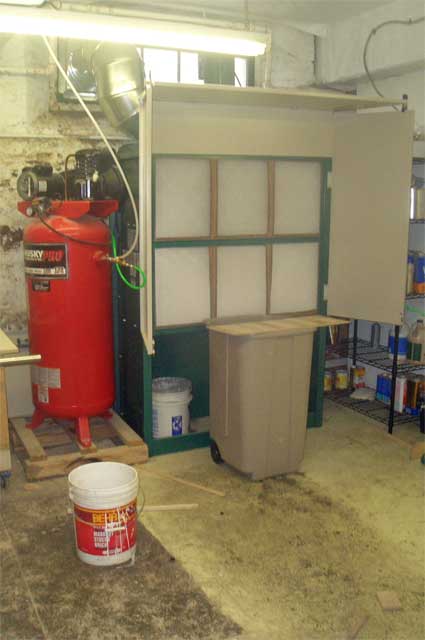
Attached is a photo of my booth purchased at Grizzly as situated in my shop in an industrial park in northeastern US. I have portable explosion proof lights and a sprinkler system over head. This thing moves so much air so fast, with my HVLP gun there is very little build up of flammable vapors.
Click here for full size image
From contributor A:
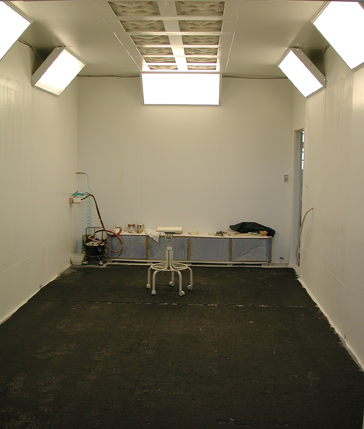
If you are spraying flammable products, you are asking for a small flash fire and possible some property damage. As for using waterborne finishes, we run a professional finishing shop and use only high end waterborne finishes. We have a booth that we built ourselves that is fully self-contained with 4 stage filtration including carbon filters that remove the VOC's from the air. We've modified it a bit more since this photo and now have AC and heated air all in the air stream.
The myth that waterborne finishes are not as durable is a bit of a farce. Most high quality waterbornes are every bit as good as any precat lacquers or CV's on the market today and in many cases the waterbornes are easier to use. Additionally waterborne finishes are generally non-hazardous, do not require explosion proof lights, fire suppressions, fire inspections etc.
Click here for full size image
From contributor A:
To contributor B: Nice booth. Are you guys in the business of selling waterborne finishes? What product do you use and where is your shop. I'm always interested in checking out new technologies that can help my bottom line. I know CA is kind of forcing the issue - I used to live and work in Burbank.
From contributor B:
Our main company is a mid sized commercial painting business. We got into the wood finishing as we do a lot of lacquer and decided to go the environmentally and user friendly route. This resulted in us becoming a distributor for a high quality coatings manufacturer that has a complete line of waterborne wood finishing products. Our shop is located in Courtenay on Vancouver Island, BC. Our company applies in excess of 20,000 liters of coatings each year with about 10-15% being clear and stained wood finishes.
From contributor C:
To contributor B: Congratulations on your beautiful booth. Does self-contained mean that there is no window in your space?
From contributor D:
Without a real booth you should only use waterborne and these days there is little reason to do otherwise. They have been doing so in Europe for many years now hence the quality of ICA and Beckers' products. I'm not saying the US manufacturers are not up to the task but the Euros have a big head start and have devoted many euros to research. I just did a kitchen for the owner of a big auto body repair shop and he was very impressed with my Beckers waterborne finish. I took that as high praise!
From contributor E:
Best thing to do is talk to a reputable booth distributor, and also get a copy of NFPA 33 outline. Talk to local fire inspectors on what they want to see. Don't jerry-rig it because it can kill you. Your booth would be illegal if going by NFPA 33. You may have explosion proof lights and switches but the compressor motor is within 3' of the face of the booth. That is an explosion hazard. Always ask local authorities before you go and spend money, because if it does go boom by some crazy happenstance, you’re covered.
