Home » Knowledge Base » Knowledge Base Article What's New  |  Site Map 


Today's
Sponsors:


BetterVacuumcups.com

Biesse Group America

Biewer Lumber

Binks

Black Bros. Co.

Blackhawk Machinery

Brown Wood Products Co.

Byrd Tool

C.R. Onsrud

Cab Parts

Cabinet Door Service Co.

Cabinet Pro

CabinetCRUNCHER Cutlist & 3D Cabinet Design Software

Cabinetmakers Association

CABPARTSPRO

CADCode

Cag Lumber

Camco, Inc.

Carbide.com

Carolina Woodworking Consultants

Carter Products

Carvewright

Carving Technologies

Cash Coatings

Castle

Catskill Timber Industries

Central Hardwoods

Charles G.G. Schmidt Co.

Chicago Dowel Company, Inc.

CIM-Tech

Clear Lake Lumber

CNC Auto-Motion

CNC Parts Dept.

3M Corporation

5 Star Tooling

A Brazilian Wood Depot

Abrasive Resource

Accu-Right Squareness Gauge

Accu-Router, Inc.

AceCo Precision Wood Tooling

Activa

Active Machine & Tool

Air Cleaning Systems

Air Handling Systems

Alan McIlvain Company

Algoma Lumber Co.

All Star Adhesives

Alliance Millsoft

Allied Machinery Inc.

AllRout

Amana Tool

Ameitech South

American Fabric Filter Co.

American Institute of Building Design

American National Woodworking Knife

American Rotary Converters

Andreou Machinery

ANEST IWATA USA, Inc.

Antique Beams and Boards

Antique Building Materials

Anver Corporation

Apollo Sprayers Inc.

Arbor Processing Inc.

Architectural Elements

ArtCam

ATEMAG

Atlantic Machinery Corp.

Auton Motorized Systems

AWFS

B.H. Davis Company

Bailey's Inc.

Bainbridge Manufacturing

Baker Products

Banks Hardwoods

Barn Detail

Barn Door Lumber

BC Wood Specialties Group

BeamsRUS

Beaver Tools

Benz Incorporated

Best Cabinets


WOODWEB DISCLAIMS any and all RESPONSIBILITY and LIABILITY for the accuracy and application of the information below. Readers agree to evaluate the significance and limitations of the information provided, and accept full responsibility for the application of this information. Read More ...

Would you like to add information to this article?
Interested in writing or submitting an article?
Have a question about this article?


Spraying Pigmented Lacquer       Details on cure time and finishing racks. January 15, 2004

Question
I've got a big job coming up with all MLC white lacquer. I have sprayed a couple small cabinet jobs with it, but this will be a complete home. I know that pigmented lacquer takes longer to cure. What is the amount of time I need to allow before putting doors back together? Any tricks I should know?

Forum Responses
From contributor A:
Typically, I would let it dry for a full 24 hours before messing around with it. If you're doing the bed and bath doors, screw two pieces of 3/4" plywood to the bottom of the door so it stands vertically. That way you can spray both sides at one time. Sure has been a huge time saver/headache reducer.

Are you using Clawlock, too? That stuff is awesome.


From the original questioner:
I have not ordered anything yet. Is Clawlock a sealer - primer? I have always used Magnalac white primer/under coat and Magnamax opaque base.


From contributor B:
Screwing a bottom base to a door so that you can spray both sides is a fantastic idea. But then space considerations loom larger than usual because you have to wait a long time before you can place the doors on a rack.

But if you have the place to let them stand, then you really have a good thing going.

Please tell me about the dimensions of the bases you are making for these doors. And tell me some details about the logistics that you have to plan in moving them about, before you spray and after.

Do you walk around the doors while you spray or are you stationary and turn the doors on a turntable?


From the original questioner:
The doors will all be 42 inches. I spray them and set them in a door rack, which holds 14 doors. I usually spray one side, let dry/cure for about an hour - that's with clear lacquer. I'm hoping I can do the same with the tinted lacquer, but allow a lot more time before doing the other side. A day? I will have trim to sand, so time is no big deal. I'm at home and have only a couple hours a day, except weekends. This works great for me. Any other ideas?


From contributor C:
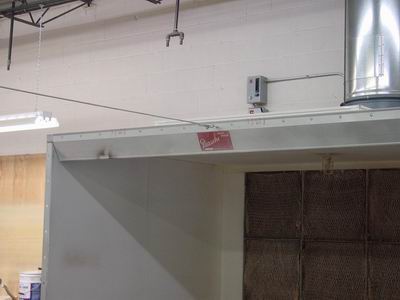
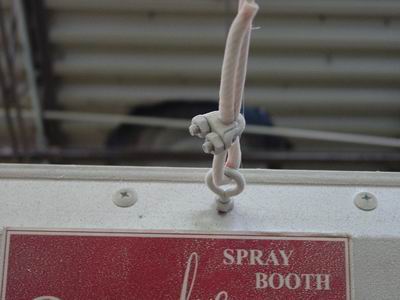
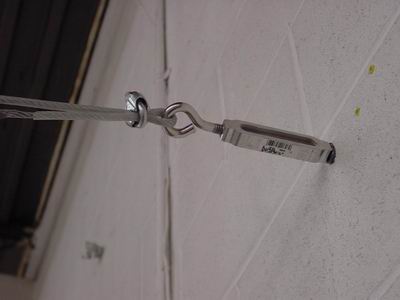
I have a spray booth and I do the following. I used two turn buckles, one at each end. I attached 1/4" cable wire and clamps to each turn buckle. One is mounted to the face of my spray booth and the other, with a piece of machine thread and cement epoxy, is glued into the concrete. I then twisted my turnbuckle onto the machine thread and clamped the cable wire on. I twisted the big eye on at both ends, so they pull away from each other, and essentially pull the cable wire tight.

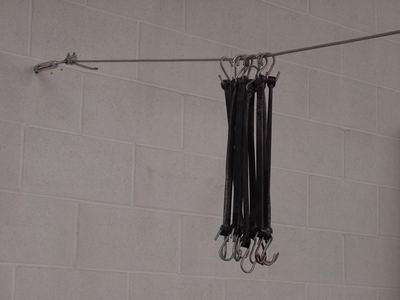
I use the hard rubber bungee cords to hang my doors from.

I drill the 35 mil hole and hinge my doors. I then take an eye hook, fully closed, and screw it into the hole where my hinge screw goes. One in each side of the door, so a total of two eye hooks. Then I take the door and hang it on the stiff rubber bungee cord and away I go.

That way I can finish both sides of the cabinet door and not have to put any holes into the door from mounting when finishing.
Clawlock is a Primer and works very well. I'm not too impressed with the undercoater. I think that Clawlock covers better. You will need to thin it out, though, as it is very thick.

You don't need to have a spray booth to tie a cable wire from one end to the other. You'll just have to epoxy the machine thread into the concrete wall on each end.

P.S. If you're going to do one side at a time and put it in your rack, you'll need to let it dry for more than 12 hours to assure it won't leave any impressions in the lacquer. Flipping lacquered doors over is a bit different than painted doors. Keep in mind that if you get so much as a pin size hole in the painted lacquer, you'll see it. I love painted finishes, but they are such a pain to make flawless.


From the original questioner:
I see you must spray your doors outside your spray booth. How many can you do at a time? And do they stay right where you spray them to dry? I do a lot of flat work. Haven't done much other except a few tables and dressers. No problems with sags or runs?


From contributor C:
Yes, I spray just outside of the booth. You do have the option to tie the cable inside the back area of the booth, too. You typically only want to spray one at a time, but when you're done spraying that one, grab the bungee cords and move it to the very end and so on. Kind of like an assembly line. If one cable wire isn't enough, do an additional one. It works great.

Yes, you do have to steady the piece as you're spraying it. I spray all of my edges first and then spray the front and back. For smaller pieces, you'll have to hold the top or the bottom as you're spraying so it won't go flying around. For the tiny bit of hassle, it works great and really cuts down the time of spraying.

You really have to dial your gun properly so you don't get runs. I got some when I first started this method, but with a little bit of practice, it will go fine.

I also have a "Finishing Tree". I took casters and screwed it to the bottom of two pieces of 3/4" 24"x24", then I made a rectangle box to stand straight up. Approximately 7x7. I then screwed pieces of 3/4" x 2 x 18 on each side to act as "branches" and worked my way around the "trunk". I made it about 7 ft tall. Make sure the base of this trunk is wide enough so it won't tip over. I learned the hard way!


From the original questioner:
Thanks for your help. I might just try this out. I sure like the idea of doing both sides at once.


From contributor C:
Trust me, it works like a champ.

Another advantage to doing it this way is that you don't get overspray on the back side like you do when you lay it down and do one side at a time. Even if you flip end for end, you still end up with overspray with your last coat.

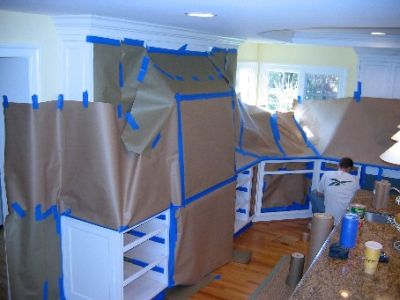
All of the items you see in the pictures are Home Depot items.

When I do spray shelving, I take two pieces of 3/4" x 2 x 12 and staple it to the back side of the shelf so it stands up and I can spray both sides of the shelving.

Hint: When you manufacture your cabinetry, always try to find a way to finish things with the back off. It makes a world of difference in the finishing process. I always build with a separate back that gets screwed on after the finishing is done.

Have you reviewed the related Knowledge Base areas below?
  • KnowledgeBase: Finishing

  • KnowledgeBase: Finishing: General Wood Finishing

  • KnowledgeBase: Finishing: High Speed Production

  • KnowledgeBase: Finishing: Refinishing


    Would you like to add information to this article? ... Click Here

    If you have a question regarding a Knowledge Base article, your best chance at uncovering an answer is to search the entire Knowledge Base for related articles or to post your question at the appropriate WOODWEB Forum. Before posting your message, be sure to
    review our Forum Guidelines.

    Questions entered in the Knowledge Base Article comment form will not generate responses! A list of WOODWEB Forums can be found at WOODWEB's Site Map.

    When you post your question at the Forum, be sure to include references to the Knowledge Base article that inspired your question. The more information you provide with your question, the better your chances are of receiving responses.

    Return to beginning of article.


    Refer a Friend || Read This Important Information || Site Map || Privacy Policy

    Letters, questions or comments? E-Mail us and let us know what you think. Be sure to review our Frequently Asked Questions page.

    Contact us to discuss advertising or to report problems with this site.

    To report a problem, send an e-mail to our Webmaster

    Copyright © 1996-2008 - WOODWEB ® Inc.
    All rights reserved. No part of this publication may be reproduced in any manner without permission of the Editor.
    Review WOODWEB's Copyright Policy.

    The editors, writers, and staff at WOODWEB try to promote safe practices. What is safe for one woodworker under certain conditions may not be safe for others in different circumstances. Readers should undertake the use of materials and methods discussed at WOODWEB after considerate evaluation, and at their own risk.

    WOODWEB, Inc.
    RR4 Box 265A
    Montrose, PA 18801

    Contact WOODWEB