Squirting Tree Phenomenon
Other Versions
Spanish
French
Stand back: trees in wet locations, infected with bacteria, may squirt smelly water when cut. Here, experts explain why. August 29, 2006
Question
I was telling a good buddy about a tree I cut down once, and the same thing had happened only once to him as well. Mine was a Colorado cottonwood, his a Maine hemlock. I put a small notch into the cottonwood, and as I came through with the back cut, the chips were really watery. After the tree went down, a fountain of water probably 2 to 3 inches in diameter continued to shoot straight up into the air from the heartwood to a height of maybe three inches for a number of seconds before it stopped.
There was no evidence of a spring under, around or near the tree that I could find that could have somehow been pressurizing the heartwood. When I told my buddy about it, he said the same had happened to him with a hemlock once, but that his didn't have enough pressure to go vertical, that the stump pumped out a huge volume of water in a short time, then stopped. Have you ever heard of this? Or have any idea what was going on?
Forum Responses
(Sawing and Drying Forum)
From contributor J:
It happens here with almost every cottonwood you cut down if it is growing in low land around the rivers.
From contributor D:
Did you cut the tree about this time of the year, spring?
From Professor Gene Wengert, forum technical advisor:
This is actually the result of an anaerobic bacterial infection in the tree. At night, you can even get a supply of methane that (if you use a nozzle on a hole cut into the tree) can be ignited and will glow with a blue flame.
The trees most likely to have this effect are cottonwood, hemlock and willow, although the bacteria are found in all species. This is also associated with extremely high MCs and also a rancid odor. (The bacteria create fatty acids that turn rancid and that is the source of the smell and gas.)
From contributor O:
Did the end look like this? Note the separation of the annular rings.
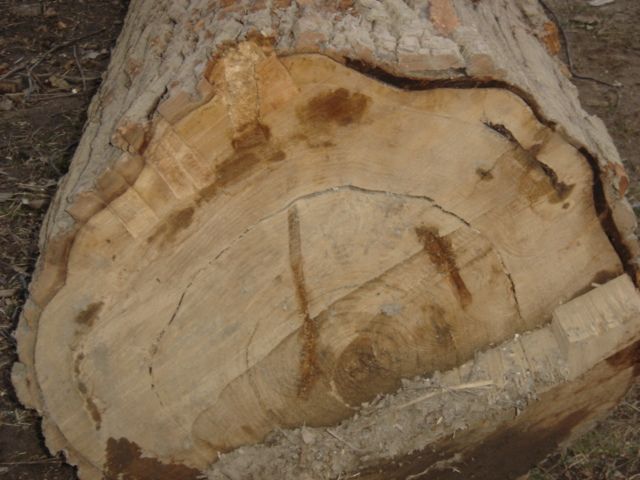
Click here for full size image
From Gene Wengert, forum technical advisor:
Great example of bacterially infected wood.
From contributor R:
So can you get cottonwood to spalt? I have not seen any. That would make the stuff more interesting. Okay secondary wood, if you are in a pinch. But barely worth sawing for me.
From Gene Wengert, forum technical advisor:
Understand that spalting is caused by a fungal infection, while the previous discussions are related to bacterial infections. The white rot fungus (that causes spalting) will get into cottonwood, but often goes so fast that it really deteriorates the wood quickly. Also, blue stain fungi go rampant and destroy the wood's color. So, the functional answer is that you cannot easily spalt cottonwood.
From contributor R:
Doesn't spalting and even fungal infection only occur in dead wood, even if the tree is still standing and parts are alive? I know what spalting is - I know guys who are in the market and actually bury logs to speed up the process - but is spalting wood in the beginning of the rotting process? What are the black lines? I've heard that they are where two bacteria meet each other. True? I am also into woodturning and have met various times with internationally known David Ellsworth, who says the composition of the black lines is about the hardness of sea shells. Isn't the wood dust from spalted wood also toxic, carrying bacteria infected spores?
From contributor B:
Years ago when I was cruising timber in Minnesota, we had to core drill a lot of trees for ring counts, and quite often when we pulled the core out of the hole, we would get sprayed with a strong stream of some of the smelliest water ever. It was quite a sight, and even humorous, now and then.
From Gene Wengert, forum technical advisor:
The spalting is caused by a white rot fungus, so it is indeed decay. The zone lines are just chemicals that are deposited and are not adding to the hardness, but if the wood dries for any reason, then it can get harder where it is dry. So spalted wood is drier and that may be why you heard about hardness. A living tree does not have enough air to support fungal growth, so the wood must be dead in the decaying area.
The comments below were added after this Forum discussion was archived as a Knowledge Base article (add your comment).
Comment from contributor X:
We observed the fountain coming out of a walnut stump after we cut down the tree but:
1. The article discussion confuses two phenomenon, one with smelly infected liquid and the perfectly clear fresh fountain I and others have observed; and
2. We cut in the winter but it was only when spring came that the fountain erupted from the heartwood, 3-6 inches high, a thick flow and it lasted for more than a week.
3. After the week, the tree stump shot up new tree starts all around where the live cambium is.
4. We are trying to understand the forces that drove the water from the underground water table up into the air.
