Today's
Sponsors:


Elias Woodwork & Manufacturing

Endeavor Hardwoods

Erecta-Rack

ETK International

EX-FACTORY

Excel Dowel and Wood Products Inc.

Extrema Machinery

FastCap

Felder USA

Festool

Finish Systems

Firth Maple Products

Flap-Wheels.com

FormWood Industries

Freeborn Tool Company

Freedom Machine Tool

Fuhr International

Fuji Spray

Gary M. Katz

Goby Walnut Products

Graco, Inc.

Great Lakes Kiln Drying Association

GreCon

Green Valley Wood Products

GUHDO

Hanson and Leja Lumber Company

Hardwood Council

Hardwood Store of N.C. Inc.

Heartwoods, LLC

Hendrick

Her-Saf

Hermance Machine Company

Hi-Knoll Cedar, John Langstroth Consulting

Historical Plus Wood

Centre for Advanced Wood Processing

Charles G.G. Schmidt Co.

Chicago Dowel Company, Inc.

Classic Designs by Matthew Burak | tablelegs.com

Clear Lake Lumber

Clear Vue Cyclones

CNC Parts Dept.

CNCROUTERSTORE.com

Colonial Saw

Construction Programs and Results

Cook's Saw Mfg.

Coulee Region Hardwoods

Country Saw & Knife, Inc.

CP Adhesives

CSH Custom Service Hardware Inc.

Cutlist Plus

Cutting Edge CNC

Delta Power Equipment Corporation

Denray Machine

Digital Wood Carver

Dispoz-A-Blade

Don Hall & Associates

Donald Dean and Sons

Eagle Bay Cabinet Doors and Drawers

Eagle Machinery and Repair Co.

Eagle Mouldings

ECabinet Systems

Edge-It Edgebanding

Electrophysics


Staircase Wainscoting Layout

      Basic advice on laying out wainscoting for a stairway. December 27, 2008

Question
I’m looking for help in both pricing and planning for a stair wainscoting project. I already have job to do in an adjacent dining room and the customer wants me to add a foyer and stairs. I have done straight wianscoting, but not stairs. This will be true raised-panel painted work.

On pricing, I'm guessing the three angled sections, plus the one transitional straight section on stair landing, while far shorter in linear footage than a 16 x 12 dining room, will take more time both making and installing. I do have the luxury of laying out/templating the work right on the walls. But I will build full frame-and-panel assemblies (cope-and-stick) in the shop and prime before installing. Let's say I'm getting $6500 for a dining room (fully installed and painted); how much are the stairs worth? Are there any good references where I can see good design info on stair wainscoting work?
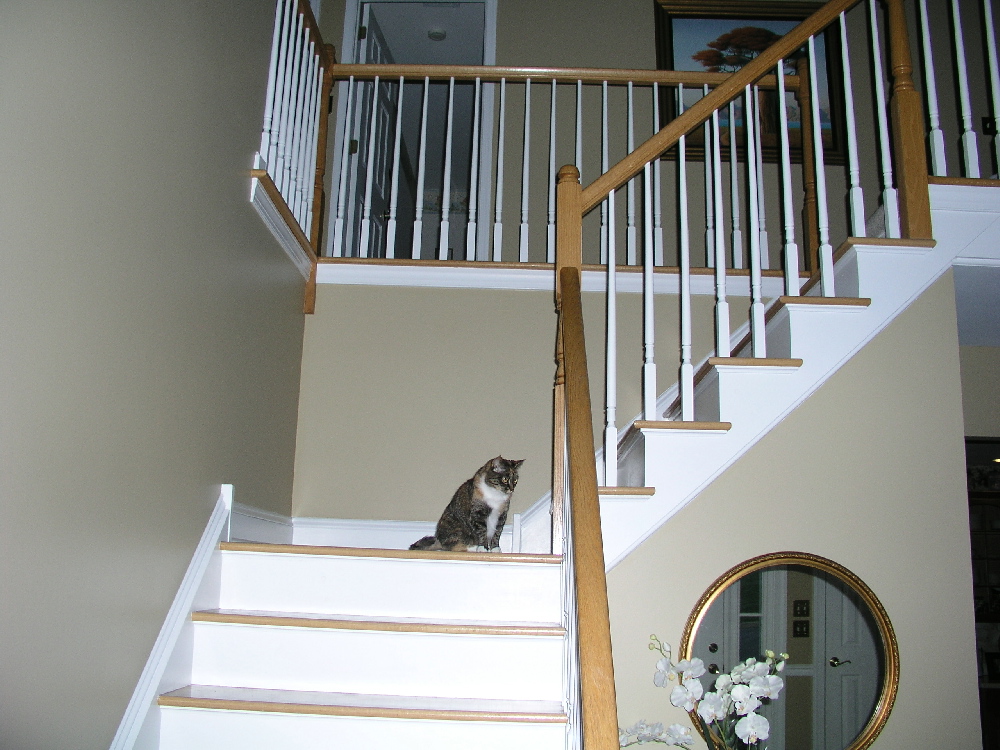

Click here for full size image

Forum Responses
(Architectural Woodworking Forum)
From contributor J:
I'm an installer, so I can't help with much of what you need. But if this is going to be inspected, be sure your work does not narrow the clear area width of the stairs to less than code allows. Sometimes this comes home to bite.


From contributor T:
I did the EXact job in 05. 15 x 12 dinning out to and around the foyer and up the steps, I even put a secret storage under the first set of risers. A little push and you have a place to hide the "good booze" when company comes.

We did the stairs the same way you "see" it. I made templates with wood strips and a hot melt glue gun. (just like the top shop) shop produced our sections to the templates and the install was a breeze. We went $75 ln/ft, did our own install and paint and broke even. We were way ( 50% - 75%) off.


From contributor S:
A couple of things to note:

1. Brush up with Pythagoras and A^2 + B^2 = C^2, you'll be using it every step of the way.

2. Determine the slope of your staircase from the stair stringer, not the treads and risers. The small measurements from the treads/risers eg. 8" rise, 10" run, do not provide the precision required for fabrication. Errors in slope determination will magnify on taller paneling. You'll need to be within +/- .2 degrees on 36" wains and even less with 42".

3. Be sure and take slope measurements from each of the individual flights within the stairwell. Separate flights may have different slopes and to use one slope for the entire job will lead to parts that don't fit.

4. Take note of the height of the plumb cuts on the stair stringer at the top and bottom of the section. If either of these measurements are > 0, you'll have to adjust the height of your paneling in one of the sections to accommodate the difference.



From Gary Katz, forum technical advisor:
Contributor T's idea of the templates is perfect. I usually make them from 1/8 in. plywood on the jobsite. Be careful about the transition stile locations. The skirtboard miters can be misleading if you want your bottom rail miters to line up with the transition stiles.


Would you like to add information to this article?
Interested in writing or submitting an article?
Have a question about this article?


Have you reviewed the related Knowledge Base areas below?
  • KnowledgeBase: Knowledge Base

  • KnowledgeBase: Architectural Millwork

  • KnowledgeBase: Architectural Millwork: Millwork Installer


    Would you like to add information to this article? ... Click Here

    If you have a question regarding a Knowledge Base article, your best chance at uncovering an answer is to search the entire Knowledge Base for related articles or to post your question at the appropriate WOODWEB Forum. Before posting your message, be sure to
    review our Forum Guidelines.

    Questions entered in the Knowledge Base Article comment form will not generate responses! A list of WOODWEB Forums can be found at WOODWEB's Site Map.

    When you post your question at the Forum, be sure to include references to the Knowledge Base article that inspired your question. The more information you provide with your question, the better your chances are of receiving responses.

    Return to beginning of article.


    Refer a Friend || Read This Important Information || Site Map || Privacy Policy || Site User Agreement

    Letters, questions or comments? E-Mail us and let us know what you think. Be sure to review our Frequently Asked Questions page.

    Contact us to discuss advertising or to report problems with this site.

    To report a problem, send an e-mail to our Webmaster

    Copyright © 1996-2012 - WOODWEB ® Inc.
    All rights reserved. No part of this publication may be reproduced in any manner without permission of the Editor.
    Review WOODWEB's Copyright Policy.

    The editors, writers, and staff at WOODWEB try to promote safe practices. What is safe for one woodworker under certain conditions may not be safe for others in different circumstances. Readers should undertake the use of materials and methods discussed at WOODWEB after considerate evaluation, and at their own risk.

    WOODWEB, Inc.
    335 Bedell Road
    Montrose, PA 18801

    Contact WOODWEB


  •   Home » Knowledge Base » Knowledge Base Article