Stickering Wood in the Basement
Getting wood to dry in a cellar is problematic. July 18, 2008
(Sawing and Drying Forum)
Question
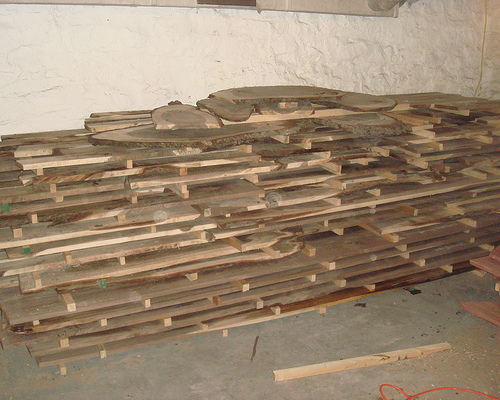
My friend and I recently took 4 trees to the mill. One of them was a healthy walnut. We had it all cut at 5/4. It was all frozen when I brought it into my basement shop. I've included a picture of my stack. Let me know if you see anything wrong with it. I still have to add weight to the top. Any ideas would help. I was thinking concrete blocks or sand bags? I have a small dehum but I will probably stick with just fans for now.
Click here for full size image
Forum Responses
(Sawing and Drying Forum)
From contributor D:
The only thing I see that might cause problems is that your stickers aren't lined up. This image is from an article about air drying lumber.

Click here for full size image
From contributor T:
Contributor D's right about the sticker alignment. Not having them aligned vertically can cause the boards to sag between stickers as the weight from above is not transferred through the stickers below.
I would also elevate the stack off of the floor to allow air flow under it. As the wood dries it sets up a subtle chimney effect that draws air up through the stack. The stack needs good air flow under it to allow this to happen. And make sure there's at least 1' of clearance between the wall and the stack so air flow from the fans has somewhere to go.
Walnut is pretty forgiving. Other than what has already been mentioned, and being that it is in a basement, the only other concern I would have is mold.
From contributor S:
Sorry, but you’re going to have to re-stack the whole pile. I agree with keeping it away from the wall. I'd put the dehumidifier right next to the pile for now. After a few months, you could try to cover the pile and the dehumidifier with a heavy, airtight plastic sheet or tarp. It would be a crude dehumidification kiln. Placing a few box fans behind the pile will help air flow. Set them on the lowest setting for now. When you re-stack the pile, inspect the lumber for any evidence of insects and put those boards outside the house or trim off the buggy part.
From the original questioner:
Thanks for the quick replies. It looks like I have some work to do. I am also going to elevate it when I start the new stack. How high would you guys go?
From contributor J:
I would also stack it with the stickers as mentioned above, but create a "chimney" effect with the bottom boards wider apart and slowly bringing them tighter towards the top, creating a wide area at the bottom tapering upwards to draw air. Air movement will be important in your basement, mold loves that environment.
From contributor A:
There is quite a bit of information in the Knowledge Base about air drying - just type in air drying and then search. There have been discussions here about air drying in basements and one thing that comes up is the relative humidity of most basements is higher than is optimal for drying so you will only be able to get the moisture content down so far before you need to move it or use another method for further drying.
As others here have mentioned I would definitely stack the pile again and align the stickers and if possible give yourself 4" to 6" space under the pile to promote air movement. Then move it out from the wall a bit for air movement as well. Some fans will be helpful and a dh wouldn't hurt.
From contributor S:
My advice to you would be to put the longest boards at the bottom, and with wide spacing, to use the chimney effect. Then, if feasible stack boards that are 1/2 the length of the bottom boards, in 2 halves so they weight the stack below. Then add your 3/4 length above, add weight, or strap down.
From Gene Wengert, forum technical advisor:
This stack is small enough that it will not require a chimney.
From contributor W:
There is a lot of water in that wood, and that water will stay in your basement unless you have some way to vent it effectively. Basements are usually already damp, so the water in your wood will exacerbate this problem.