Structural Concerns for Boat Cabinetry
A proposal for a free-standing entertainment center on a boat sets off a discussion about appropriate technology in nautical cabinetry. July 30, 2007
Question
I work on Cape Cod and have a friend who needs a large entertainment center for his boat. 8 ft long, 7ft 6 - 8 ft high, 20+- deep. He wants it freestanding, except bolted to floor. There's a double wall divider in the middle, so it can be closed, basically creating a 40" x 48" box. The box can be bolted tightly at the bottom, but being top heavy is a problem.
How to keep it from wracking itself in the constant movement of a boat? I can use a couple of nylon straps, but think this is too little support. I was thinking double-ply base, with sides dovetailed in. Also dovetailing sides to top, as well as a shelf (above center).
Forum Responses
(Furniture Making Forum)
From contributor S:
I would suggest running all-thread from top to bottom and tying it into the joists (or whatever they are on boats). Maybe a stainless plate at the top to distribute torque. Steel can be your friend (as says my steelworking buddy) when it comes to strength. He has made some great suggestions to me on different projects. If there is stainless on the boat, you could also work it into the design so it is visible. If this boat is one that actually goes into rough seas, it will see a lot of torque placed on it.
From contributor Y:
I am a boater as well as a woodworker. It sounds to me you're on the wrong track. I don't know how big the boat is or the layout, but most cabinetry in a boat is built in place, and kept as light as possible but still strong. Free standing bolted through the cabin sole is not going to work unless you're on a small lake. Try to build it in to a bulk head in place if possible. More information about the boat would be useful. But whatever you do, it has to be fastened so that it can not come over in rough water. Just going through the cabin sole is headed for big trouble, and someone could get hurt, as well as pull the cabin sole up.
From contributor R:
This must be a big boat. 7and-a-half to 8 feet tall? Exactly how high is the ceiling in this boat? I ask because this sounds quite unusual. If those measurements are in fact accurate, you should consider tying this thing to the ceiling. I will echo the other comments in that if this boat is intended for the open sea, rather than inland waters (bit of a simplification - some inland waters, like the Great Lakes, can get horribly rough), the construction needs to be uber robust.
I live on a boat, and have done the majority of my own woodwork. I've been knocked around pretty good, and all my stuff has held up. But I wouldn't consider a piece 8' high and 20" wide fastened only through the base.
From the original questioner:
Thanks a lot - great insight! I'm going to cut height to 6', and build as an L tied into vertical post. One heavy strap should hold it closed. I'm thinking aluminum base that can swing open, basically a pallet, cut in half and hinged.
From contributor R:
You said "1 heavy strap should hold it closed." Do you mean using a strap to hold the doors closed when underway? If so, no disrespect, but that's pretty kludgy. There is proper hardware to do this. My favourite is one that is used on many commercial yachts and ships (and I used it on my own cabinetry). It is made by Lamp and available through Sugatsune. It is their TLP model. It is a pop-out push button device that has a spring-loaded friction catch for normal use (when the knob is "popped out") and then you push the knob in to engage a dead-bolt. Very slick and elegant, and very secure.
Here's an example of the TLP in use. The bottom left image in the picture (side view) shows a 1/8" shim between the latch and the door. That's because I used 5/8" ply. The latch requires a min 3/4" panel.

Click here for higher quality, full size image
From contributor R:
Dang, wrong picture. That one had two close-ups of the locked position.
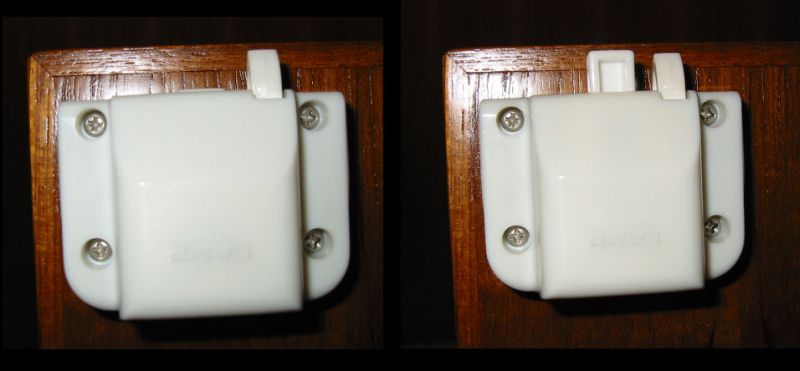
Click here for higher quality, full size image
From the original questioner:
Thanks a lot. Customer and I are redesigning. I will definitely look into hardware closer. My first job quite like this, so if anything, it will be overbuilt and safe.
From contributor E:
Well, sounds like some stability is in order here. Might be visually nice to see this cab connected at the top and the bottom. Maybe held off the floor and short of the ceiling with stainless or brass tubing. Best if the tubes could be total height and through cabinet interior, 4 tubes with single flanges or plates to join and fasten. Sounds like a fun job.
From contributor O:
Adding weight to a vessel should be done judiciously. Misplacing weight in a vessel can adversely effect stability, trim, and seakeeping ability (rate and depth of roll). Check with a naval architect or a ship's licensed deck officer. There's a reason everything is built in. Calculations have been made, and the last thing you want in a seaway is something heavy broken loose and sliding about. (See loose canon!)
