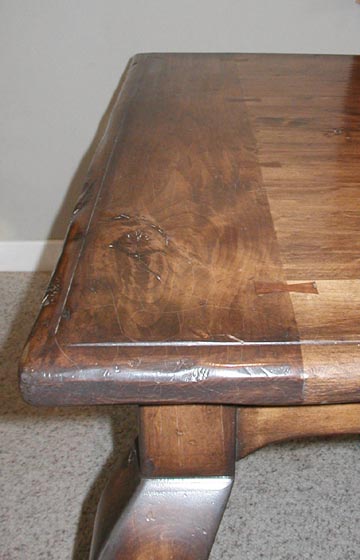
Table Top and Base Proportions
Because table height is generally a constant, the ratio between table top and base needed to provide stability varies with table diameter. October 28, 2005
Question
Does anyone know, either by formula or experience, what the footprint size of the base of a round table should be in proportion to the top size? To be specific, the table is 96" in diameter with a round base as well. I realize that the weight of the base has some bearing, but let's assume that it is hollow and constructed of the same material as the top.
Forum Responses
(Furniture Making Forum)
From contributor A:
There are no hard and fast rules that I'm aware of but the weight of the top in relation to the base has to be considered, as well as what kind of seating will be used. I would go with at least a 60" diameter on the base.
From contributor B:
I'm not a professional, but I just built a round dining table, and had to deal with the same issue. From what I was able to research, the ratio of base diameter to top diameter is variable because the geometry that counts has one near-constant: the height above the floor. My table top is 30" above the floor. Diameter is 60 inches. In that range, the diameter of the base needed to be 50% of the diameter of the top. For mine, that meant 30". For a larger diameter top, since the height above the floor doesn't change, the percentage (ratio) can drop. In your case, it could probably to not more than 42" diameter and still be rock steady. A weighted base might reduce that further, but my base is a circle of spindles with nowhere to hide more weight, and glass panels in the top so that the base can be seen from above. Since knee space even at 50% is better than 24" for your 96" diameter top, even a 48" diameter base doesn't risk the comfort of anyone seated at it.