School of Natural Resources
Department of Forestry
November 1992
by Professor Gene Wengert
When drying lumber that will be used in furniture, cabinets, millwork, and the like, the final two steps of the drying process are equalizing and conditioning. Equalizing is a procedure to equalize the moisture content (MC) from piece to piece, as well as equalize the MC within individual pieces. For most hardwood lumber uses, the maximum MC variation within a piece and the maximum variation from piece to piece cannot exceed ±1%. Conditioning is a procedure to relieve the drying stresses (sometimes called tension set or casehardening) in the lumber, so that when the lumber is ripped, resawn, or heavily machined, it will not warp. It is important to note that unless lumber has been equalized properly, it cannot be conditioned uniformly.
Oftentimes, the processes of equalizing and conditioning are not done satisfactorily. As a result, the user of the lumber experiences manufacturing problems related to improper equalizing and conditioning. These problems include open glue joints, warping during machining, and movement after manufacturing.
This article describes the requirements and procedures for equalizing and conditioning practical terms that the kiln manager and operator can adopt into their operating procedures. A special section is included on conditioning to relieve longitudinal stress.
Equalizing
It is normal, as lumber is dried, for some pieces to dry more quickly than others. This difference can result because of differences in the lumber (for example, sapwood pieces dry faster than heartwood, and thin pieces dry faster than thick pieces) and/or because of differences in the drying conditions (that is, differences in temperature, humidity and velocity).
Further, it is normal to see differences in MC within an individual piece of lumber. These differences can result because of the reasons cited above and because end grain dries faster than flat grain; because the end of a piece of lumber is drier than the middle; and because knots and the surrounding swirly grain are drier than flat grain regions.
Additional man-made factors influencing or causing MC variation before equalizing include mixing lumber with different initial MCs in the kiln (for example, mixing freshly sawn lumber with lumber that has been partially air-dried), mixing different species and mixing different thicknesses.
As a result of all these factors, it is common when drying a load of lumber to see some pieces of lumber reaching the target final MC before other pieces do. (Oftentimes, kiln samples do not show much variation in final MC. This is because the samples are mistakenly chosen to represent only the wettest part of the load, rather than representing the true cross section of MCs in the load. Further, kiln samples are almost always dried on the outside edge of the load and, therefore, dry more quickly than pieces in the center of the load.)
General Equalization Procedure
If sampling and operating procedures are correct, all the lumber in the kiln will be between target %MC and [target - 2] %MC at the end of equalization.
With lower-valued products and with lumber that will be used for products that do not require extreme moisture content uniformity, it is possible to change the limits given above to "3% below the target." That is, begin equalizing when the driest piece is 3% MC below the target and use an EMC that is 3% below the target. Equalizing stops at the same point--when the wettest lumber is at the target. This "3% below the target" approach will result in faster equalization, but may produce slightly lower quality lumber, especially in terms of warp and machinability.
Equalizing Example
Assume that the final target is 7% MC. Equalizing would begin when the driest sample is at 5% MC (7% MC - 2% MC = 5% EMC). Set drybulb temperature at 170°F (unless the kiln schedule calls for a lower temperature). Set the humidity controls in the kiln to achieve 5% EMC. Referring to the data in Table 1, this EMC is achieved with a 35°F depression, or a wet-bulb temperature of 135°F. (Additional wet-bulb temperature settings for different dry-bulb temperatures and different target MCs are given in Table 1.)
Specific Operating Procedure for Equalizing
Inject steam spray to raise the humidity in the dryer. When the moisture from the steam condenses on the lumber, heat is released (about 1100 Btu's per pound of water). This heat is beneficial when equalizing, as moisture within wetter pieces of lumber will move more rapidly to the surface than if the heat were not present.
On the other hand, caution must be taken when steam is introduced into the kiln, as it is possible that the heat released from the steamspray humidification system will also raise the actual dry-bulb temperature above the desired set point, creating undesirable conditions.
Table 1. Traditional wet-bulb temperatures for equalizing.
| Final | Equalizing | Dry-Bulb Temperatures | ||||||
| MC | EMC | 140 | 150 | 160 | 170 | 180 | 190 | 200 |
| % | % | °F | ||||||
| 5 | 3 | 92 | 101 | 110 | 120 | 130 | 140 | 150 |
| 6 | 4 | 99 | 108 | 118 | 127 | 137 | 147 | 157 |
| 7 | 5 | 105 | 115 | 125 | 135 | 145 | 156 | 167 |
| 8 | 6 | 111 | 121 | 131 | 141 | 152 | 163 | 174 |
| 9 | 7 | 115 | 125 | 136 | 146 | 157 | 168 | 179 |
| 10 | 8 | 120 | 130 | 140 | 151 | 162 | 172 | 183 |
Table 2. Traditional wet-bulb temperatures for conditioning
| Final | Conditioning | Dry-Bulb Temperature | |||||||
| MC | EMC | 140 | 150 | 160 | 170 | 180 | 190 | 200 | |
| % | % | % | °F | ||||||
| (Hdwd) | (Sftwd) | ||||||||
| 5 | 6 | 9 | 123 | 133 | 144 | 154 | 165 | 175 | 186 |
| 6 | 7 | 10 | 126 | 136 | 147 | 157 | 168 | 178 | 188 |
| 7 | 8 | 11 | 128 | 138 | 149 | 159 | 170 | 180 | 190 |
| 8 | 9 | 12 | 130 | 140 | 151 | 161 | 172 | 182 | 192 |
| 9 | 10 | 13 | 132 | 142 | 152 | 163 | 173 | 183 | 193 |
| 10 | 11 | 14 | 133 | 143 | 154 | 164 | 174 | 185 | 195 |
To avoid this latter problem of over heating, keep the dry-bulb temperature during equalizing above the dry-bulb temperature used in the final step in the schedule. For example, assume that the final dry-bulb temperature of the schedule is 160°F, with a 115°F wet-bulb temperature. Equalize at 170°F and 135°F (per previous example). Note that the dry-bulb temperature for equalizing is 10°F higher than the final dry-bulb temperature in the schedule.
To attain the 170°F dry-bulb temperature initially, use heat from the steam spray rather than heat from the heating coils. To avoid heat in the heating coils, set the dry-bulb temperature set point to a low value or turn off the main heating valve. In other words, because the spray injected to increase the wet-bulb temperature also raises the dry-bulb temperature, the desired conditions are achieved--thereby 'killing two birds with one stone.' Once the correct wet-bulb temperature is achieved, turn on the dry-bulb heat.
Conditioning
It is normal for lumber, as it dries, to develop drying stresses or "casehardening." These stresses result when the outer cells begin to dry and try to shrink, while the interior cells, which are still wet and not drying or shrinking, will not permit the outer cells to shrink. As a result, the outer cells dry in an enlarged state, called "tension set." Tension set results in casehardening in dry lumber. To relieve tension set, moisture needs to be quickly added to the outer cells, causing them to try to swell. The interior cells resist this swelling, creating a compression set, which offsets the tension set.
Because the process of regaining moisture at the surface is influenced by its MC, variations in lumber MC will influence the conditioning process. This is why equalization is the first step for proper conditioning. In addition, because moisture absorption is faster in low-density species, stress relief will be faster for these species. The conditioning process will take longer for thicker species.
When adding moisture to the surface, there is a risk that the amount of swelling will create more compression set than there is tension set. If this happens, the lumber is said to be "reverse casehardened." Reverse casehardening cannot be relieved or eliminated. It is, however, difficult to create too much compression set with lumber thinner than 1-1/2 inches using high kiln temperatures. The moisture supplied to the surface rapidly moves into the core, causing the core to swell and relieve some of the surface stress.
Appreciate that the amount of tension set varies with a variety of factors. The faster the lumber is dried when at high MCs, the greater the amount of tension set. The thicker the lumber, the higher the potential for high tension set. High-density species with slow moisture movement and high shrinkage tend to have high levels of tension set.
General Conditioning Procedure
The conditioning process involves the rapid increase of humidity in the kiln at as high a temperature as possible. The process is most effective if the moisture is steam vapor rather than small, liquid water droplets. The conditioning procedure is as follows:
During the conditioning process, the lumber will regain about 1% MC. The lumber should, therefore, be at a final MC of target MC ± 1%. However, moisture gradients in the lumber should be allowed to dissipate before the lumber is processed further. This waiting period is often called 'cooling' or 'tempering.' Failure to wait long enough will lead to warping after machining.
Most of the stress relief occurs during the first several hours of steaming. After approximately 18 hours with 4/4 lumber, additional conditioning will result in further addition of moisture to the lumber, but with little added stress relief. Thicker lumber often requires longer conditioning time and longer subsequent cooling time to eliminate moisture gradients.
Conditioning Example
Assume that the final target is 7% MC. Conditioning would begin after equalizing brought all of the lumber pieces to a MC between 5% and 7%. Set the dry-bulb temperature to 180°F. For hardwoods, the humidity in the kiln must be 11% EMC ([7% MC + 4% MC] = 11% EMC). Using the data from Table 2, this EMC would be achieved with a 10°F depression, or a wet-bulb temperature of 170°F. Additional wet-bulb temperature settings for different dry-bulb temperatures and different target MCs are given in Table 2.
Specific Operating Procedure for Conditioning
On the other hand, when steam is introduced into the kiln, it is possible that the heat released from the steam spray humidification system (called 'superheat') will also raise the dry-bulb temperature above the desired set point, thereby creating undesirable kiln conditions. That is, the dry-bulb temperature may be much above the set point, and the EMC achieved will be much lower than desired.
To avoid this problem of over-heating, keep the dry-bulb temperature during conditioning above the dry-bulb temperature used for equalizing. For example, assume that the equalizing dry-bulb temperature is 170°F, with a 135°F wetbulb temperature. Condition at 180°F and 170°F (per previous example). Note that the dry-bulb temperature for conditioning is 10°F higher than the equalizing dry-bulb temperature.
Further, to attain the 180°F dry-bulb temperature initially, use the heat from the steam spray rather than heat from the heating coils (the same procedure as used for equalizing). Turn off heating coils by using a low dry-bulb temperature setting on the controller or by manually closing the heating valve. As the spray for increasing the wet-bulb temperature also raises the dry-bulb temperature, the desired conditions are achieved--thereby 'killing two birds with one stone.' Once the correct wet-bulb temperature is achieved, turn on the dry-bulb heat.
Condition 4/4 lumber for 4 to 18 hours, depending on the amount of drying stress; final MC; wood density; amount and temperature of steam; amount of superheat and thoroughness of stress relief required. Thicker lumber requires slightly longer conditioning times.
(Special note: When stress relief, especially longitudinal stress relief, cannot be achieved satisfactorily using standard procedures, try this alternative procedure. After equalizing, cool the lumber for several hours. Leave the kiln doors and vents open with the fans running and the heating and humidifying systems turned off. Then, close the doors and spray steam into the kiln without heat. As the lumber's surface will be quite cool, the moisture from the steam will condense on the lumber's surface, providing rapid stress relief. Conditioning times may be as short as two hours. But, be careful. The process is sensitive to the amount of cooling, and there is a substantial risk of reverse casehardening if cooling is excessive or conditioning is prolonged.)
Longitudinal Stress
When resawing or ripping lumber, lumber will occasionally warp during, or immediately after, machining. If the two pieces cup, when resawing, the problem is transverse stress--the stresses discussed heretofore. If, however, the two pieces develop side bend or bow (that is, longitudinal or lengthwise warp), then the problem is longitudinal stress.
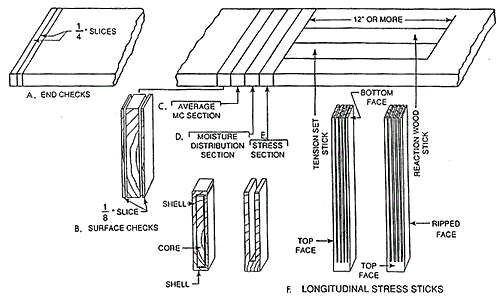
If the lumber was conditioned normally, yet longitudinal stress is still present, it is not at all unusual for the transverse prong test to show no stress. Measure longitudinal stress by cutting longitudinal stress tests (Figure 1, page 6).
Longitudinal stress results because the wood is shrinking longitudinally. Longitudinal shrinkage results when reaction wood (tension wood in hardwoods or compression wood in softwoods) or juvenile wood is present in the lumber. Longitudinal stresses are most likely to be unrelieved when conditioning temperature is too low (below 160°F); when conditioning EMC is too low (especially common when superheat in the steam spray elevates the dry-bulb temperature and thereby increases the depression above the desired value); or when conditioning time is too short.
Relieve longitudinal stress by conditioning at 180°F or higher. This will rapidly add moisture back to the lumber's surface (provided the lumber was properly equalized and the desired EMC was reached promptly, as with transverse stress relief). When adequate longitudinal stress relief cannot be attained using the procedures recommended for transverse stress relief and using 180°F or higher, then raise the wet-bulb temperature setting 1°F over the recommended value. Conditioning may also have to be extended several hours, especially for 6/4 and thinner stock.
Figure 1. Quality samples that can be prepared from partly or fully dried lumber. A. End checks; B. Surface checks; C. Average moisture content section; D. Moisture distribution section; E. (Transervse) Stress section; and F. Longitudinal stress sticks.
Gene Wengert is Extension Forest Products Specialist, University of Wisconsin-Madison, Department of Forestry, 1630 Linden Drive, Madison, WI 53706
University of Wisconsin-Extension - United States Department of Agriculture - Wisconsin Counties
Cooperating and Providing Equal Opportunities in Employment and programming
