Reprinted with permission from Modern Woodworking.
By Dr. Fred M. Lamb

It is one of those “fundamental principles” that to efficiently and effectively dry lumber, you must move air of a uniform and controlled temperature and humidity and that air must pass uniformly over the surface of the lumber. In this capacity, airflow performs two major functions. First, it transfers the heat energy to the wood in order to evaporate the water. Secondly, the air carries away the evaporated water vapor from the surface of the lumber.
Air velocity and drying rate
When drying begins with green or high moisture content lumber, there is a considerable amount of water at and near the surface of the wood. Thus, a considerable amount of water molecules have only a short distance to travel (diffuse) to reach the surface. The water is essentially waiting for the air to transfer energy to the wood (to evaporate the water) and then to carry the water vapor away. When the lumber has a low moisture content, the amount of water at the surface is much less and the water molecules in the core have farther to travel to reach the surface. This diffusion of water toward the surface is slow. Therefore, as an analogy, rather than the water waiting for the air, as is the case with green lumber, the air is waiting for the water in dry lumber.
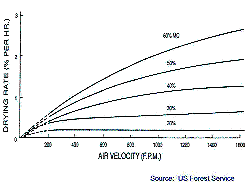
Figure 1. The effect of air velocity and moisture content on drying rate.
Figure 1 shows the relationship between drying rate and air velocity for different levels of moisture content of the wood. As the graph shows, at 60 percent moisture content, the drying rate increases with increasing air velocity. At 20 percent moisture content, drying rate is generally unaffected by air velocity increases.
The practical use of air velocity
In general, for high moisture content lumber, as the air velocity increases, the drying rate increases, the drying is more uniform and there is less warp and stain. However, with the higher air velocity comes the greater risk of checking, splitting and honeycomb. Conversely, with low air velocity at the higher moisture contents comes the increased risk of warp (especially cup), staining and non-uniform drying. Therefore, air velocity is a tool (just like temperature and humidity) to control the rate of drying. However, it is a tool that is useful above 40 percent moisture content. At 20 percent and below, air velocity beyond the minimum has little effect on drying rates. Between 40 and 20 percent moisture content, air velocity plays a proportionally decreasing role.
As the air moves across a stack of lumber, its temperature decreases and its relative humidity increases. This temperature drop and relative humidity rise depends on the volume of airflow. As the velocity increases, there is an increase in volume of airflow through the sticker spaces. If there is more volume of air moving across the lumber surface, there will be a smaller temperature drop and a smaller relative humidity rise. With a lower volume of air, the reverse is true.
The volume of air is related to both velocity and sticker thickness: the higher the air velocity, the more volume of air across the lumber, and the thicker the stickers, the more volume of air. However, it must be remembered, that for a constant volume of air supplied by the fans, an increase in sticker thickness will cause a reduction in the air velocity across the lumber. This will reduce the drying rate, but will make for a more uniform drying throughout the load. A lower relative humidity may be needed to offset the lower air velocity to maintain an appropriate drying rate.
It is this relationship between relative humidity and air velocity that is extremely important and often overlooked. At a given air temperature, a low air velocity may require a lower relative humidity (larger wet bulb depression) to increase the drying rate to the required level. Conversely, a high air velocity may require a higher relative humidity (smaller wet bulb depression) to reduce the drying rate to the appropriate level.
If the volume of air across the load is too low, the air quickly increases in relative humidity. This creates a drying gradient across the load. Long fan reversal times aggravate this problem and can result in an increase in checking. The solution is to use shorter fan reversal times: two-hour reversal is best, three-hour is satisfactory, and four-hour reversal is the maximum that should be used.
Loading and baffling
Often in a dry kiln, the problems associated with airflow are not the result of equipment or hardware, but the result of improper loading and baffling. When drying high moisture content wood, the problems of airflow are not just too much or too little, often they are also the uniformity of that airflow.
What is the “best” air velocity?
The standard hardwood dry kiln schedules are based on an air velocity of about 350 feet per minute. If your air velocity differs significantly from this, you may have to adjust the relative humidity (or wet bulb depression) to compensate for the difference. It is best to keep the air velocity on green oak to a maximum of about 300 to 350 feet per minute (and maybe even less for lowland or thicker stock). However, for easy-to-dry woods such as yellow-poplar, air velocities of 600 feet per minute and greater can be used. I would suggest that for conventional kilns, the minimum air velocity would be about 200 feet per minute. Too low an air velocity increases the risk of non-uniform drying.
Fred M. Lamb is Professor and Extension Specialist, Department of Wood Science and Forest Products, Brooks Forest Products Center, Virginia Tech, Blacksburg, Virginia. Dr. Lamb can be contacted at 540-231-7256; Fax: 540-231-8868
Reprinted with permission from Modern Woodworking.