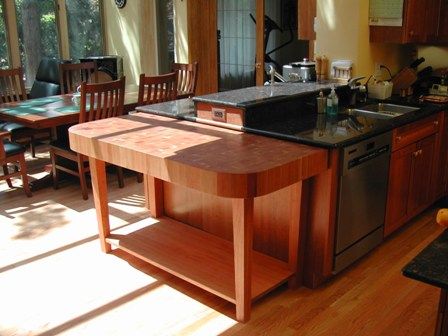
Thick Butcher Blocks
A discussion of construction methods and wood movement issues for a six-inch-thick butcher block top. April 11, 2008
Question
I'm building a small wine cabinet for a kitchen designer's project. It is to have a 6" thick butcher block top, all vertically oriented end grain walnut. In my mind this is a recipe for disaster during seasonal changes in humidity. Any advice is much appreciated. I can use any size, squares or rectangles of the 6" walnut blocks to make up the whole top. It will get a Danish oil type finish and will not be used for preparing food - just for looks. The top will be 30" x 16".
Forum Responses
(Furniture Making Forum)
From contributor J:
I saw one made out of maple in class once - the legs were essentially long blocks - therefore the entire unit moved as one piece as the seasons changed. No problem - just orient every piece vertically and it will move as a unit.
From contributor A:
I basically agree with contributor J's response. Butcher blocks with end grain up is one typical way. Where you are likely to encounter difficulty isn't with humidity induced motion, per se, but the internal stresses from humidity. Your block will move as a unit, as pointed out, however, if your glue joints aren't completely square, the stresses will be uneven. This could lead to some joints opening. To minimize this, I'd suggest staggering the glue joints, so even if one joint opens, it can't travel any further.
From contributor P:
The stress in this kind of construction tends to happen at the top and bottom of the block - the end grain sucks up moisture faster than the side grain in the middle of the block. Traditionally, this wasn't much of a problem because the end grain was thoroughly sealed with fat and blood. If your client doesn't intend to use the block this way then there is much more potential for trouble. The block could be finished with a barrier type finish, but then it won't look much like a real butcher block and it certainly won't work the same way. I would make the client aware of the potential for cracking and have them sign a document that clarifies all of this.
From contributor B:
Make the top 2" thick with a 6" skirt, grain in the same direction so that it appears as a solid block. For a nonfunctional block this would be a good solution.
From the original questioner:
Thanks for all the input. I am going to recommend the 2" top with a 6" skirt as suggested. Thanks. It will be easier to build this way as well.
From contributor L:
One of the best things you can do to make a piece like this is use small squares, say 7/8", and alternate the grain direction with every square. Easiest way is to use both quatersawn and plainsawn boards, but with care you can use any boards - you'll just have to do lots of examination. You can use an even number of squares, glue up long rows, and flip layers after cross-cutting to change direction between squares in both dimensions. I agree that 6" at edges with 2" inside makes sense, and saves a lot of wood without losing any functionality. Finish with walnut oil mixed with beeswax - use wax rich mixture, and heat the piece and the finish before applying. Finish top and bottom. Give customer some of the finish to maintain.
From contributor W:
You could dovetail it like this.
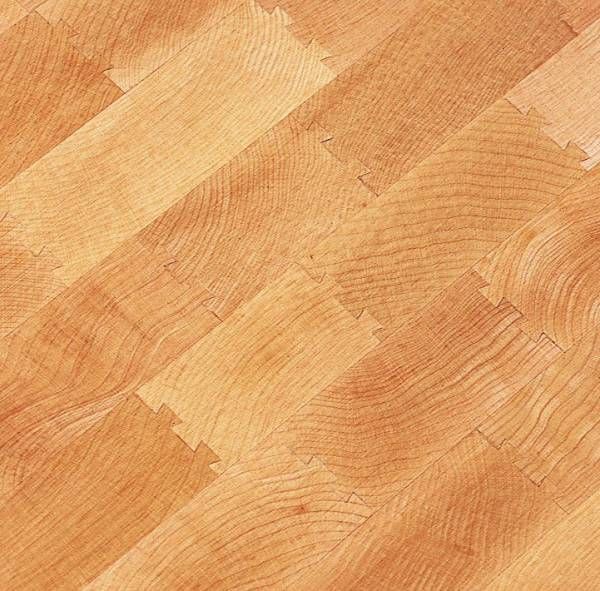
Click here for higher quality, full size image
From contributor G:
There are companies such as mine that specialize in pieces of butcher block. The size you are asking for is a simple job for us. Check out the end grain cherry block below; it was 6" thick and 50" long and 30" deep.