Today's
Sponsors:


Vintage Wood Products

VortexTool Co. Inc.

VyTek

W. Moore Profiles, Ltd.

W.L. Fuller

Wagner Electronic Products

WalzCraft Industries

WEIMA America, Inc.

Weinig Group - USA

Western Dovetail

Williams and Hussey

Wisconsin Knife Works

WMIA

WMMA

Wood Doctor's Rx, LLC

Wood Technology Inc

Wood-Mizer

WoodCabinetDoors.Com

WoodenBoat

WoodFinder

WoodJobs.com Search Consultants

WoodLINKS

Woodmaster

WoodPlanet Inc.

WoodSprayGuns.com

WOODWEB

Woodworker's Supply/woodworker.com

Woodworker's Directory

Woodworking in America

Wright Timber

Specialtytools.com

Speed Sander

Spink Lumber

Sprayguncaptain.com

Stefani

Steve H. Wall Lumber Co.

Stiles Machinery

Stiles Shop Solutions

Stoneys Hardwoods

Super Source Tooling Inc.

Supergrit Abrasives

Superior Wood Products

T-Tool USA LLC

Target Coatings

TaylorCraft Cabinet Door Company

Techno CNC Routers

Template Services

The Veneer Store

Thermwood Corporation

Tiger Wood Ltd.

TigerStop

TigerwoodDecking.com

TimberKing

Timesavers Inc.

TMS Machinery Sales

Tomlin Architectural Millwork

Tooling on the Web

Toolstoday.com

Top Drawer

Touch Up Solutions LLC

Tractivity

TradeJobPlacement.com

TradeSoft

Trakware Systems Inc.

TRB Flooring Company

Tropical Hardwoods

True North Cedar

Ubidmachinery Inc.

UC Coatings Corp.

Unique Building Supples

Unique Machine & Tool

University of Wisconsin

UWMO Auctions

VacDry Kilns

Vacuum Pressing Systems, Inc.

Vacuumpods.com

Valspar

Vecoplan LLC

Vector Art 3D

Vectric Ltd.

Veneer Systems Inc.


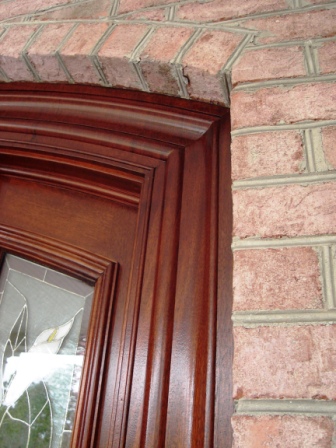
Tips on Making Radius Moldings       Explanation and examples of radius arched door casings. September 15, 2006

Question
We recently bought a US Concepts radius moulder, and tonight I ran a radius casing made from yellow pine. I used a stack laminated method like a butcher block and then the arch was cut from that. It made a mess. I really do not have the time to strip laminate and run it that way. Does anyone have any ideas or has anyone done this type of machining using my method? One of my competitors uses the same method and his seemed to come out fine. His arches were cherry and maple. Could I wet the wood and then machine it and sand it afterwards? My knives were sharp, by the way. Feeding the arch from left to right the cross grain leading into the head did fine and the cross grain machining away from the head tore out.

Forum Responses
(Solid Wood Machining Forum)
From contributor A:
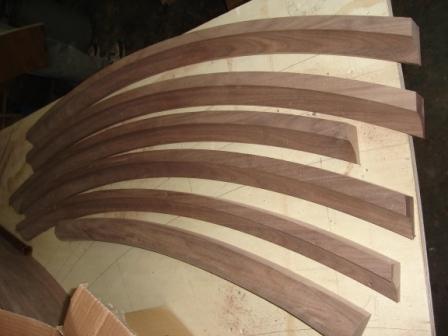
This takes awhile to learn and you will only get better by doing it over and over. If you understand the steps here it's easy to make the pieces separately and then nail them in place but if you have a large profile then it's best to glue the pieces together first and then profile them. Butt joint it with two biscuits or a loose tenon. Make an inside and outside track for the blank to follow and mould away. Taking light passes is better.
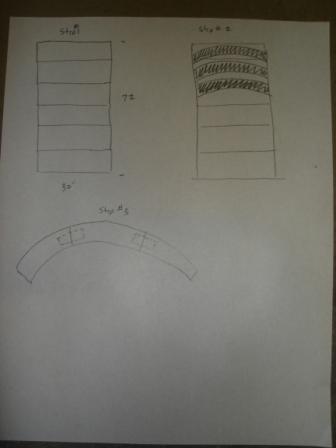
Click here for full size image


From contributor A:
Here are small pieces.


Click here for full size image


From contributor A:
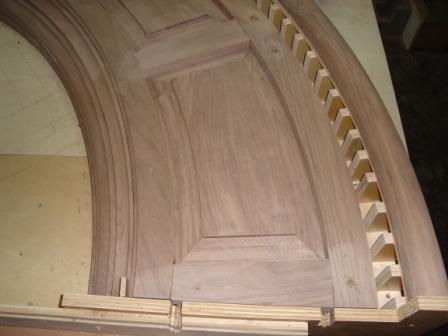
Here is a door casing - 22"wide.


Click here for full size image


From contributor A:
This was glued together first and then machined on the Williams and Hussey.


Click here for full size image


Would you like to add information to this article?
Interested in writing or submitting an article?
Have a question about this article?


Have you reviewed the related Knowledge Base areas below?
  • KnowledgeBase: Knowledge Base

  • KnowledgeBase: Architectural Millwork

  • KnowledgeBase: Architectural Millwork: Moldings


    Would you like to add information to this article? ... Click Here

    If you have a question regarding a Knowledge Base article, your best chance at uncovering an answer is to search the entire Knowledge Base for related articles or to post your question at the appropriate WOODWEB Forum. Before posting your message, be sure to
    review our Forum Guidelines.

    Questions entered in the Knowledge Base Article comment form will not generate responses! A list of WOODWEB Forums can be found at WOODWEB's Site Map.

    When you post your question at the Forum, be sure to include references to the Knowledge Base article that inspired your question. The more information you provide with your question, the better your chances are of receiving responses.

    Return to beginning of article.


    Refer a Friend || Read This Important Information || Site Map || Privacy Policy || Site User Agreement

    Letters, questions or comments? E-Mail us and let us know what you think. Be sure to review our Frequently Asked Questions page.

    Contact us to discuss advertising or to report problems with this site.

    To report a problem, send an e-mail to our Webmaster

    Copyright © 1996-2009 - WOODWEB ® Inc.
    All rights reserved. No part of this publication may be reproduced in any manner without permission of the Editor.
    Review WOODWEB's Copyright Policy.

    The editors, writers, and staff at WOODWEB try to promote safe practices. What is safe for one woodworker under certain conditions may not be safe for others in different circumstances. Readers should undertake the use of materials and methods discussed at WOODWEB after considerate evaluation, and at their own risk.

    WOODWEB, Inc.
    RR4 Box 265A
    Montrose, PA 18801

    Contact WOODWEB


  •   Home » Knowledge Base » Knowledge Base Article