Today's
Sponsors:


Cab Parts

Cabinet Door Service Co.

Cabinet Pro

CabinetCRUNCHER Cutlist & 3D Cabinet Design Software

Cabinetmakers Association

CADCABINETS.COM

CADCode

Cag Lumber

Cantek America

Carolina Woodworking Consultants

Carter Products

Carving Technologies

Castle

Catskill Timber Industries

Charles G.G. Schmidt Co.

Chicago Dowel Company, Inc.

Clear Lake Lumber

CNC Parts Dept.

CNCROUTERSTORE.com

CNT Motion Systems

Colonial Saw

2Sand.com

3M Corporation

A O M Spray Equipment

Abrasive Resource

Accu-Router, Inc.

AceCo Precision Wood Tooling

Activa

Air Handling Systems

Alan McIlvain Company

Algoma Lumber Co.

All Star Adhesives

Alliance Millsoft

Allied Machinery Inc.

AllRout

Amana Tool

Ameitech South

American Fabric Filter Co.

American Institute of Building Design

American National Woodworking Knife

American Rotary Converters

ANEST IWATA USA, Inc.

Antique Beams and Boards

Antique Building Materials

Anver Corporation

Apollo Sprayers Inc.

Architectural Elements

ArtCam

ATEMAG

Auton Motorized Systems

AWFS

B.H. Davis Company

Bailey's Inc.

Baker Products

Barn Door Lumber

BC Wood Specialties Group

Beaver Tools

Benz Incorporated

Best Cabinets

BetterVacuumcups.com

Biesse America

Biewer Lumber

Binks

Black Bros. Co.

Blackhawk Machinery

Briquetting Solutions by Sunomi LLC

Brown Wood Products Co.

Business Management Solutions

Byrd Tool

C.R. Onsrud


Vacuum Dried Red Oak       Achieving quality and color. May 19, 2004

Question
How many of you have used red oak lumber that was dried in a vacuum kiln? How much stress do you run into? Nothing to worry about? Enough to be a problem? Is there anything you like or dislike about lumber dried in a vac kiln?

Forum Responses
From contributor D:
Not all vacuum kilns are created equally.

Besides better color, I often hear that it's more machinable.


From the original questioner:
I don't feel that our vac kilns cause a great amount of stress. All I am trying to do is prove it. Years ago, when they dried 200,000 BFT of lumber through our vac kilns, the greatest complaint was stress. That was then. This is now. Some things have changed.

I should also add that color isn't a problem with maple, but it is with the sapwood in oak and cherry. It works well to steam the cherry. Steaming red oak for color change is a pipe dream.


From Gene Wengert, forum technical advisor:
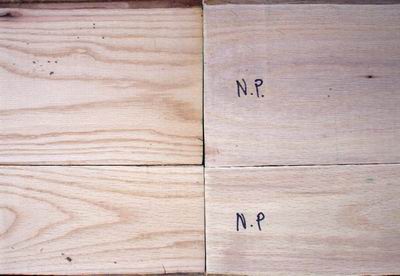
The picture below shows two pieces of red oak lumber that were cut in half. The left half was steamed (Elder Steaming Process) while the right ends were not processed (N.P.). After steaming, the lumber was dried identically and then planed. The lack of gray stain and the brightness of the sapwood can easily be seen.


From the original questioner:
How was the oak dried? When I tried steaming red oak and then drying in a vac kiln, all I got was a lot of bow and honeycomb.

P.S. I started my kiln charge of 4/4 RO at 100/98.


From Gene Wengert, forum technical advisor:
The oak was air dried and then kiln dried.


From contributor D:
Have you ever thought about steaming inside a vac kiln?


From the original questioner:
How the heck would you get steam to the center of the load?


From contributor K:
The only experience I have had with a vac kiln was with a company who wanted to sell us a RF vac kiln. They told us they could dry 8/4 red oak in a couple days with no degrade. They even went so far as to dry some 8/4 for us for free. After drying there was degrade due to checking, along with a variance in MC among the boards, and stress in the lumber. Needless to say, we were not impressed and did not purchase one of their kilns, nor do we plan to.


The comments below were added after this Forum discussion was archived as a Knowledge Base article (add your comment).

Comment from contributor H:
We have dried 35 mm French oak in our WDE/Maspell vacuum kiln in five days without defects. We usually do 4/4 or 2/4 for parquet boards and when properly stacked and air dried, we have no stress, no cupping, excellent and fast drying capabilities. It's using superheated steam as a heating medium at 150 mbar.



Would you like to add information to this article?
Interested in writing or submitting an article?
Have a question about this article?


Have you reviewed the related Knowledge Base areas below?
  • KnowledgeBase: Lumber and Plywood

  • KnowledgeBase: Primary Processing

  • KnowledgeBase: Primary Processing: Air Drying Lumber

  • KnowledgeBase: Primary Processing: General

  • KnowledgeBase: Primary Processing: Kiln Operation

  • KnowledgeBase: Wood Engineering: Wood Properties

  • KnowledgeBase: Woodworking Miscellaneous

  • KnowledgeBase: Woodworking Miscellaneous: Woodworking


    Would you like to add information to this article? ... Click Here

    If you have a question regarding a Knowledge Base article, your best chance at uncovering an answer is to search the entire Knowledge Base for related articles or to post your question at the appropriate WOODWEB Forum. Before posting your message, be sure to
    review our Forum Guidelines.

    Questions entered in the Knowledge Base Article comment form will not generate responses! A list of WOODWEB Forums can be found at WOODWEB's Site Map.

    When you post your question at the Forum, be sure to include references to the Knowledge Base article that inspired your question. The more information you provide with your question, the better your chances are of receiving responses.

    Return to beginning of article.


    Refer a Friend || Read This Important Information || Site Map || Privacy Policy || Site User Agreement

    Letters, questions or comments? E-Mail us and let us know what you think. Be sure to review our Frequently Asked Questions page.

    Contact us to discuss advertising or to report problems with this site.

    To report a problem, send an e-mail to our Webmaster

    Copyright © 1996-2010 - WOODWEB ® Inc.
    All rights reserved. No part of this publication may be reproduced in any manner without permission of the Editor.
    Review WOODWEB's Copyright Policy.

    The editors, writers, and staff at WOODWEB try to promote safe practices. What is safe for one woodworker under certain conditions may not be safe for others in different circumstances. Readers should undertake the use of materials and methods discussed at WOODWEB after considerate evaluation, and at their own risk.

    WOODWEB, Inc.
    RR4 Box 265A
    Montrose, PA 18801

    Contact WOODWEB


  •   Home » Knowledge Base » Knowledge Base Article