Vacuum Kiln Pump Ideas
Thoughts on vacuum pump equipment for kiln drying. August 8, 2008
Question
I have been playing around with vacuum drying wood. I need to find a place to buy a used liquid ring vacuum pump using water at a low price. This is not for commercial use, only to dry 4-500 feet occasionally. I would like to draw about 28"Hg. If anyone knows of a source it would be appreciated. Yes, I know there are other methods available but I want to learn this.
Forum Responses
(Sawing and Drying Forum)
From contributor S:
I looked on Ebay and found plenty of vacuum pumps. I don't know if any of them would fit your needs.
From the original questioner:
It needs to be a vacuum pump that can handle the moisture (and chemicals) from the wood drying. Most vacuum pumps cannot handle this, and that is why I am looking for an economical liquid ring pump, or any style that could withstand moisture, etc.
From contributor C:
I own and run a VK-2000, and have both replaced and rebuilt the pump. You need the stainless steel version, the brass is prone to corrosion from the moisture pulled from the wood. Red oak is particularly nasty to them. They are also a bit tricky to work, as they need either a constant supply of cool fresh water or open loop, or a way to cool the water circulating in a closed loop system. If you can't cool the water, they don't pull vacuum. Also avoid copper and steel fittings, they corrode quickly as well. I rotted out a steel nipple in six loads, and copper core heat exchanger in six months, PVC and SS now for two years no problems.
I purchased a rebuilt SS SIHI for $2800, I was quoted $5700 for new a few years ago, and the rebuild kits are about $150. You might be able to figure out a water separator, along the lines of a cyclone in a dust collector system or using a high CFM desiccant air line dryer or filter that would enable you to run a rotary vane or regenerative pump, which may be cheaper. I would talk to someone who knows a lot more about them than I do.
From contributor D:
You don't need expensive SS pumps if you use a condenser. Below is a new cast iron/bronze pump on a VK-2000 from the days when I rebuilt
WoodMizers.
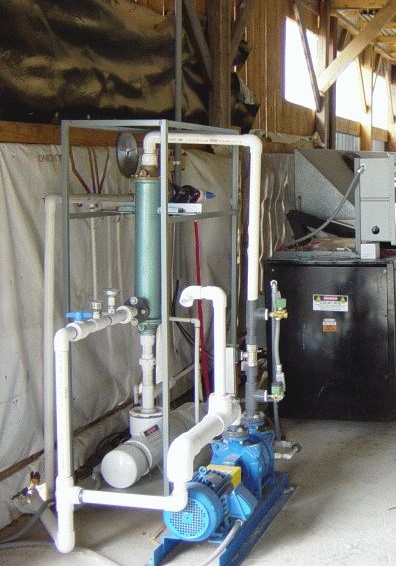
Click here for full size image
From contributor C:
Contributor D - Perhaps you could expand on the condenser idea for TEG-II a bit, as it sounds like the part I was envisioning and couldn't come up in my first post, rather than a desiccant dryer or filter.
It sounds like the right way to pull the charge water out and keep it separate from the pump water. But in doing this, it also eliminates the need to run a LR pump. I think he can find a suitable rotary or regen pump in the size he needs cheaper than a LR, and are much easier to operate and maintain.
From contributor D:
I use single-pass shell and tube heat exchangers as condensers. The suction side of the pump connects to the top and a condensate collection tank connects to the bottom. The tank connects to the chamber. I usually use evaporative coolers to recycle the cooling water. The same water supplies the pump and heat exchanger.
