Veneering a Curved Cabinet in Place
Advice on a very tricky veneering problem: applying veneer to a half-completed cabinet with a curved face, on site. August 23, 2006
Question
I was asked to finish a job that another carpenter started and had to quit for unknown reasons. He has started building the curved bar in the picture. The front is to be covered with Zebrawood veneer and then clear coated. The veneer he purchased is a paperbacked product that I have not used before (only wood or phenolic). My question is what glue or method will work the best for applying the veneer in place without a bag and what clear finish will not penetrate the paper backing and release the glue?
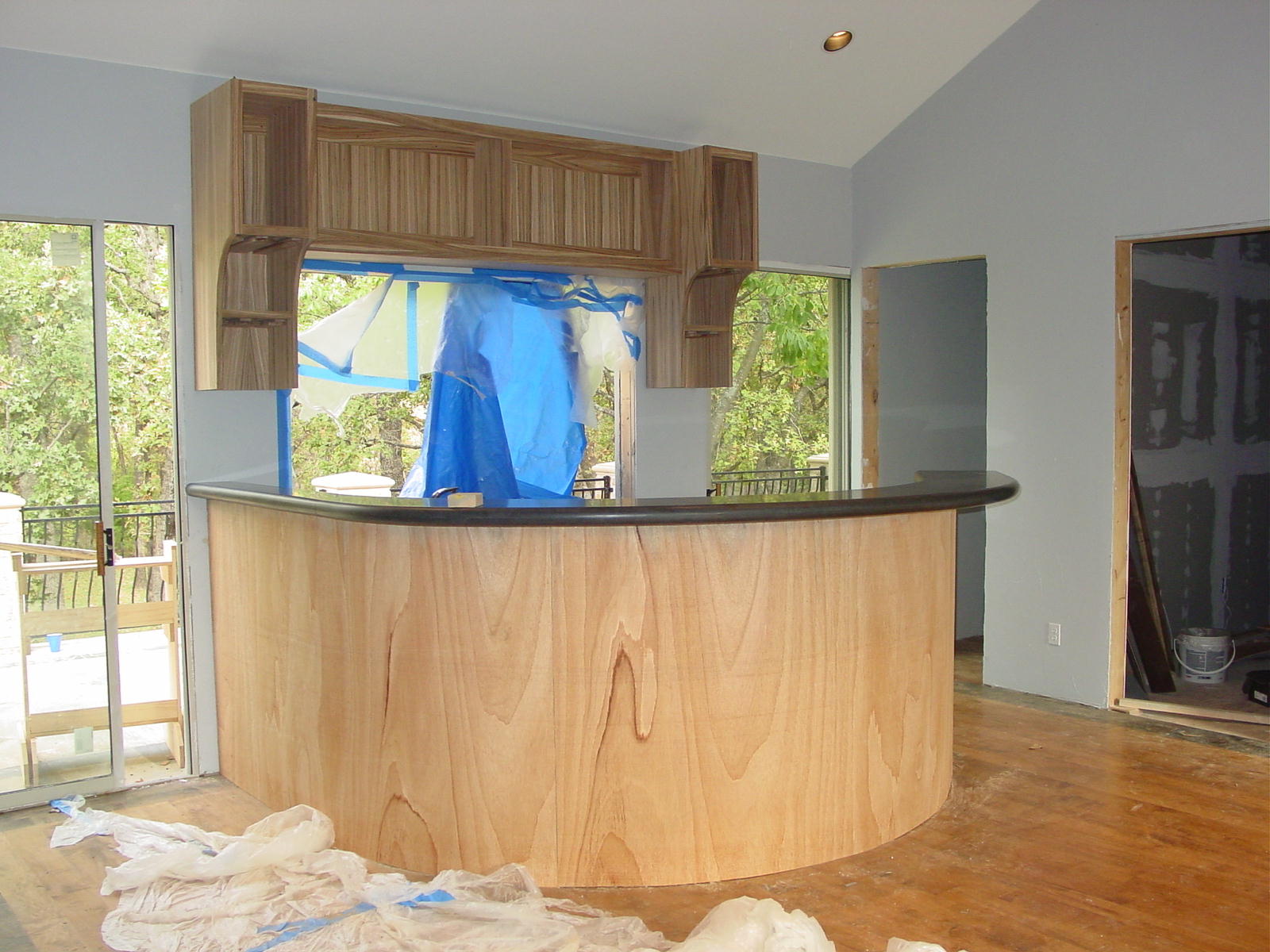
Click here for full size image
Forum Responses
(Cabinet and Millwork Installation Forum)
From contributor A:
Is this a solid substrate and not a veneer that is bubbled? If it is solid the only method I would take is contact. I know a lot of guys are going throw stones at me now but based on what you said it seems like the only alternative. Then you would finish with a waterbase poly. My method would be to keep it 2" short on the bottom and 1"short on the top. Start perfectly plumb, have sets of hands that are familiar with contact and work your way around applying pressure with a piece of 1x, not a roller or tapping block. Make sure contact is dry to the touch. Then follow with some lattice or whatever else is suitable to cover the voids on top and bottom. If the top could be removed you could let the piece fly and rout after.
From contributor B:
On site like that, anthony's got the answer. Contact is about the only way to go other than the peel and stick stuff. I think I'd make the veneer only 1/2" shorter though, and then use a small molding on top and bottom. You can spray whatever finish you decide – very, very thin coats.
From contributor C:
Use the Betterbond heatlock product sold by veneersupplies.com. The beauty of this is that you will be able to position exactly where you want before activating the adhesive, unlike contact cement which is pretty much a one shot deal. I just did a project almost exactly like this, paper backed laminate over bending lauan on a curved island almost the same size as your project. We finished with Fuhr acrylic, and it turned out great. One tip I can give you is to get a ski or snowboard iron instead of a household iron, because they don't have sharp corners or a pointed end that can damage the veneer. Also buy the glue roller they sell, it works great.
From the original questioner:
That sounds like the best idea. The granite top may be able to come off but the designer does not want to use any kind of base board - maybe just a shoe. It sounds like no matter what, I should stick with a water based finish. The substrate is bending lauan over 2x framing with a curved top plate but no bottom plate, not sure why.
From contributor E:
If using contact, take the top off first, oversize the veneer by a couple of inches, lay it over the curved face and use a compass to scribe panels to floor. Make sure veneer overlaps on joints a couple of inches - glue up veneer with contact cement 2 even coats minimum on veneer and substrate. Use 3m glue – it’s thinner and will not gum or ball up. Or use lacquer thinner to thin glue slightly - cut strips of thin laminate as culls to help place, lay on veneer as to not get any bubbles, overlap veneer at joint leaving a strip of laminate between substrate and veneer. Take a straight edge and an olfa knife or something similar and cut thru both layers. Pull out laminate and rub in the joint with a stick “perfect joint” and this will only take an hour. Rub veneer on using a soft stick such as pine "no knots". Let the veneer gas off for a few days, and make sure heat is set at 70. You can finish with lacquer if you build the first few coats lightly, allowing overnight between coats. I should have mentioned that you might want to sand substrate to get any irregularities out.
From contributor F:
I would first apply a backer sheet to the piece. We usually use a presanded p.lam which you can get from your p.lam supplier. Bending lauan is very soft and tends to telegraph both irregularities in the curve and in the grain pattern.
