Today's
Sponsors:


SII Dry Kilns

Silvaris

Simantech

Single Source Cabinet Supplies

SIS Machinery

SK-USA

SketchList

SlipCon USA, Inc.

SnapDragon Associates, LLC

SNX Technologies

South State Machinery

Southeast Tool, Inc.

Sovereign Machine, Inc.

Specialtytools.com

Speed Sander

Spink Lumber

Sprayguncaptain.com

Stefani

Steve H. Wall Lumber Co.

Stiles Machinery

Opti-Sand

Optisol for Project Scheduling

Original Saw Company

Osborne Wood Products

Paragon Enterprises

Peninsula Hardwoods

Penn Sylvan International

People Logic Software Corp.

Pinske Edge

Pioneer Lumber Company

Pioneer Millworks

Planit Solutions

Plogic Solutions Ltd.

Pond Cove Paint

Porter-Cable

Precision Drive Systems

Premium Specialty Hardwoods

Prime Estimating and Software Services, LLC

Primo Woodworking Machinery

Pro.Woodworker.com

Pro100

Professional Hardware & Supply Co.

Professional Machinery Group

Quality VAKuum Products, Inc.

Quick Machinery Company

Quickscrews International Corporation

QuickScribe

QuickWood, Inc.

QuikDrawers

R&R Drummond, Inc.

R.A.W.

R.D. Billhofer Company

Rangate

Rawles-Aden Lumber Corp.

RazorGage

Rex Lumber Company

Riethmiller Lumber

Ritter Manufacturing Inc.

Rockler Woodworking and Hardware

Roger Shaw and Associates

Root River Hardwoods

Rose Machinery

Routech

RouterCAD

Royce Ayr Cutting Tools

RT Machine Co.

Safety Speed Cut

Sand-Rite Manufacturing

Sandman Products

Sawmill and Woodlot Magazine

Schultz Forming Products

SCM Group USA, Inc.

SCM Group

SCM

Sears Trostel Lumber Co.

Shomaker Lumber Company

ShopBot


What's the Toughest Wood to Dry?       Wood Doctor Gene Wengert lists a few wood species that just love to stay wet. January 27, 2008

Question
What's the most contrary wood you have tried to dry, and why? I have heard bad things about eucalyptus and fruit woods. Pacific madrone is said to start checking as soon as it hears the chainsaw. I'm a wood turner, and I'm tearing my hair out with some pimento wood. Got me to thinking. What makes some woods easier to dry than others? Tangential to radial ratio? Do the cells' properties contribute as well? I have tried DNA, boiling, Anchorseal, plastic bag, paper bag; no success with any of these. Have not tried microwave. My next attempt will be to turn thin, green, and just let it go off. Sometimes you have to let the wood win!

Forum Responses
(Sawing and Drying Forum)
From contributor D:
If I may give my two cents, red beech (a Nothofagus) from New Zealand was the hardest wood for me to dry. The cell walls are very thick and pits, pores, vessels are very small. It is very hard for the water to find a way out. But on the other hand, water can't get back in once it is dry. Some Eucalyptus species are easy, but some others are very tough. One is difficult because the early wood dries extremely easily while the late wood doesn't want to dry at all.


From Professor Gene Wengert, forum technical advisor:
The hardest to dry is probably South American walnut (Peruvian or Columbian walnut). After a year in the kiln, it was still soaking wet. Some eucalyptus was very prone to checking, along with CA black oak. This means low success. Bacterially infected wood is nearly impossible to dry without quality loss. Thick oak (over 2.5") is nearly impossible to dry, along with beech.


From contributor D:
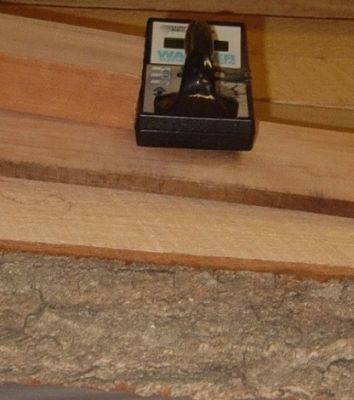
This image illustrates my point. In a vacuum kiln, it takes 12 days to dry the 12/4 red oak on the bottom. It also takes 12 days to dry the red beech on top of the red oak which was only 4/4 before surfacing. The 8/4 red beech on the left takes a whopping 24 days.
Gene, on my list of trial species coming up is one called nogal (Peruvian walnut). Sounds like I need to be careful with this one.


From Professor Gene Wengert, forum technical advisor:
Some nogal is from Mexico and is okay. Peruvian (Juglans neotropica) walnut was the bad stuff, especially 2" and thicker.


From contributor W:
I've been soaking turnings in denatured alcohol and it seems to help a lot. Something about the alcohol binding with the intercellular water and evaporating quickly once removed from the dip. I do a fair amount of madrone and this helps a lot with the checking but not the warping. Seems to dull the colors a bit, as it probably is taking out the natural oils, but all in all I've had good results. I bought at five gallon pail of alcohol and put it into a food safe plastic barrel with removable airtight lid. This is enough to totally submerge a 6" deep turning which I leave in the liquid for roughly 24 hours. We're still talking several weeks for drying, but not months.


From the original questioner:
I have tried the alcohol. That was the DNA reference in my post. Not much help. But thanks!


From contributor A:
Black locust has been bad for me (air drying).

Would you like to add information to this article?
Interested in writing or submitting an article?
Have a question about this article?


Have you reviewed the related Knowledge Base areas below?
  • KnowledgeBase: Knowledge Base

  • KnowledgeBase: Primary Processing

  • KnowledgeBase: Primary Processing: Air Drying Lumber


    Would you like to add information to this article? ... Click Here

    If you have a question regarding a Knowledge Base article, your best chance at uncovering an answer is to search the entire Knowledge Base for related articles or to post your question at the appropriate WOODWEB Forum. Before posting your message, be sure to
    review our Forum Guidelines.

    Questions entered in the Knowledge Base Article comment form will not generate responses! A list of WOODWEB Forums can be found at WOODWEB's Site Map.

    When you post your question at the Forum, be sure to include references to the Knowledge Base article that inspired your question. The more information you provide with your question, the better your chances are of receiving responses.

    Return to beginning of article.


    Refer a Friend || Read This Important Information || Site Map || Privacy Policy || Site User Agreement

    Letters, questions or comments? E-Mail us and let us know what you think. Be sure to review our Frequently Asked Questions page.

    Contact us to discuss advertising or to report problems with this site.

    To report a problem, send an e-mail to our Webmaster

    Copyright © 1996-2010 - WOODWEB ® Inc.
    All rights reserved. No part of this publication may be reproduced in any manner without permission of the Editor.
    Review WOODWEB's Copyright Policy.

    The editors, writers, and staff at WOODWEB try to promote safe practices. What is safe for one woodworker under certain conditions may not be safe for others in different circumstances. Readers should undertake the use of materials and methods discussed at WOODWEB after considerate evaluation, and at their own risk.

    WOODWEB, Inc.
    RR4 Box 265A
    Montrose, PA 18801

    Contact WOODWEB


  •   Home » Knowledge Base » Knowledge Base Article