Wood Movement and Bar Top Finishing
A finisher gets advice on a tough problem: finishing a bar top made with small wood strips over an MDF substrate.December 28, 2007
Question
Here is a picture of a nice bar top done back in June which we sprayed with SW vinyl sealer and SW CV as a topcoat. It looked very nice going out of here, but now the customer is insisting that we put a different finish on it because the strips of maple are moving and creating an edge (with gaps) in between each other, for what exact reason, I do not know. This thing is like 50 feet long and is installed and going nowhere. I am in desperate need of suggestions on what to do at this point. I need a finish that has a build to flow over top of everything and fill in the gaps between the pieces. I have been messing around with West Systems epoxy resin, but it just seems like that would be a huge disaster waiting to happen. This is very out of the ordinary for our custom cabinet shop, which strictly sprays CV and pre-cat.
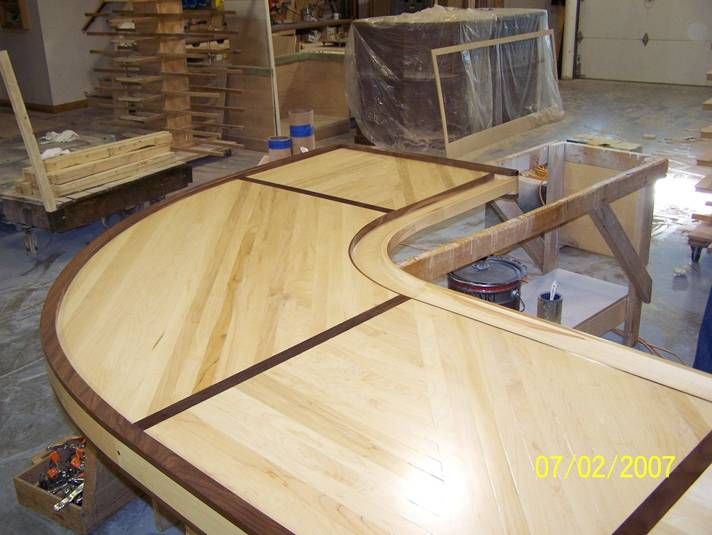
Click here for higher quality, full size image
Forum Responses
(Finishing Forum)
From contributor J:
I'm not sure what sort of finish would help you, but you might want to stall and let those strips stabilize as much as possible before attempting anything. Unless that's all veneer work (doesn't look like it), that construction was bound to move around. I'd wait until the middle of winter, when the heating system is working hard and indoor humidity is at its lowest, which should also mean that the maple will have shrunk as much as it's going to. Then your filler/finish will have at least a prayer of staying contiguous.
From contributor C:
The design of the top fails to allow for the wood's natural expansion and shrinkage cycle. I doubt that you can refinish it in a way that will be acceptable. Look into replacing this top with a more reliable design/material. Generally, it is asking a lot of a finish to expect it to prevent completely incompetent structural design from exposing itself eventually.
From contributor H:
CV is too hard a finish and does not accept movement well. Who designed this - you or the client? From the photo it looks like you made it with flooring. Orientation of the wood is all over the place with what appears to be no allowance for movement. All these strips are shrinking and the client is getting gaps. What happens when all these strips swell and have no place to go? Your next problem will be with finish thickness. Too heavy and too many finishes and it will crack all over the place. I would think about stripping the whole thing and applying a flexible floor finish like Gymseal or such. 2 part poly perhaps?
From contributor A:
You need to find the person(s) that made this top and beat them mercilessly with a copy of Bruce Hoadley's book. Well, maybe not.
The notion that you, as the finisher, are somehow responsible ("if only you used the right finish") is deflecting blame from where it belongs. Give it back to your cabinetmaker. If, by chance, you made this thing, give everyone involved their money back with a sincere apology, then stop and read and understand Hoadley's book before you do any more woodwork. There is no reasonable way to salvage this bar top.
From contributor U:
Countertops of solid wood respond to their environment - keep that in mind. The countertop is fixable, depending on the owner's willingness to work with you. Do not restrict your options on the finish. There is homework to do on the countertop's environment. I would like to see a more detailed picture of the problem.
From contributor N:
Many lessons start with a mistake - in this case grain direction and probably thickness. I have made some tops similar using a thin parquet of 1/4". (This will make a nice piece of wood go a long way. Using sequenced thick pieces that I have selected for edge grain and book or slip matching, I can create a nice pattern.) I tape it together, and dry run in a vacuum to suck any additional moisture out, then trim to shape and glue down with a good waterproof glue, and back in the bag on the substrate. Acclimation to a good dry environment before finish would be a good thing, but watch out for the bar; it is a wet area. I would do the trough with a ss liner; the corners/joints of wood will take water. I also use the CV as the sealer, not the vinyl. It will have to be stripped to do CV, as the greater thickness would peel, so consider the options of doing it over.
Who's fault? I could not say. I would hope that they will agree to work with you, as your intentions were good... I can see from your web site. Good luck, and do check out the Hoadley Book. It could be considered the bible of Understanding Wood.
From contributor R:
I know a finisher usually gets blamed for everything including the weather, but the questioner didn't build the bar - he's just finished it. Sounds to me like it's the cabinetmaker's problem to remedy and not the questioner's. Once the problem of shifting wood has been solved (however it's solved), I think the best medicine for closure has been posted by contributor H.
From the original questioner:
This thing is made with an MDF substrate and 3/8" thick tongue and groove type joints. So what you are all telling me is that even with a finish that will fill in everything to get that "bowling lane" look (these were the client's words), the wood will continue to shift and then crack the finish?
From contributor D:
In a word, yes. Either all the solid wood parts need to be able to move, as in a floor, with the inherent cracks, or it must be a veneer of some type, on a stable substrate, with a similar thickness and species and grain direction on the underside - a balanced construction.
If it is solids, you'll have a hard time turning the corner unless it is thin strips all bent to make the turn. Solid wood miters wider than 6-8" will not stay tight. Think about a 45 when it expands or contracts just a little bit. See the shrinkulator (here at WOODWEB) to see what a slight change in humidity will do to a solid wood bar top.
If you use thin solid wood - 1/8" is ideal - you can override the solid wood nature and make it behave more like veneer. Edge glue for width and then laminate top and bottom to core. Edge band and sand. Then you are ready for a durable bartop finish.
From contributor I:
We use the two part bar topper and it works great.
From the original questioner:
Well, I met with the customer and explained to him what was going on. He was very receptive. We are going to mock up about a 3' x 3' section of his bar top and play with it. Then I will show him what we can do.
What is the two part bar topper you are talking about?
From contributor Q:
No matter what finish you use, two important considerations:
1. Check the moisture content of the wood before you build. If the wood has an excessive moisture content when you start building, then it will surely shrink later on, causing possible gaps between boards.
2. Seal the backside of the lumber strips and both sides of the MDF to slow down the transgression of moisture from the underside of the bar. This is akin to "balanced construction" and is a must for any horizontal application where water is present.
If you were to glue maple the boards together, but not attach them to the MDF substrate, and design the inside and outside mouldings such that the entire top could float (expand/contract) under it, you would never have a problem.