Home » Knowledge Base » Knowledge Base Article What's New  |  Site Map 


Today's
Sponsors:


Scientific Dust Collectors

SCM Group USA, Inc.

SCM Group

SCM

SDN Contracting

Seagrave Coatings Corporation

Sears Trostel Lumber Co.

Shade Dri

Sherburne Machine Development

Shomaker Lumber Company

ShopBot

SII Dry Kilns

Silvaris

Simantech

SIS Machinery

Nebraska Tool

NEMI

New England Kiln Drying Association

Newman Whitney

Norment and Lambert

North Pacific Lumber

Northtech Machinery

NPO BARS

Nydree Flooring

Nyle Dry Kiln Systems

O'Shea Lumber Company

Old Mississippi Brick and Heart Pine Company

OMGA, Inc.

Omnitech Systems

Onsrud Cutter

Opti-Sand

Original Saw Company

Osolnik Machinery & Supplies

Paul Saws and Systems

People Logic Software Corp.

Peter Meier Inc.

Pinske Edge

Pioneer Lumber Company

Planit Solutions Inc.

plastiMACH

Plogic Solutions Ltd.

Pond Cove Paint

Porter-Cable

Precision Drive Systems

Precision Saw Sharpeners

Premium Specialty Hardwoods

Pricecutter.com

Prime Estimating and Software Services, LLC

Pro.Woodworker.com

Professional Hardware & Supply Co.

Q1 Machinery

Quality VAKuum Products, Inc.

Quick Machinery Company

Quickscrews International Corporation

QuickScribe

QuickWood

QuikDrawers

Quis Machinery

R&R Drummond, Inc.

R.A.W.

R.D. Billhofer Company

Rangate

Rawles-Aden Lumber Corp.

RazorGage

Reliance Building Products

Restoration Specialists

Rex Lumber Company

Riethmiller Lumber

Ritter Manufacturing Inc.

Rockler Woodworking and Hardware

Roger Shaw and Associates

Rose Machinery

Routech

Royce Ayr Cutting Tools

RT Machine Co.

Safe Passage Consulting

Safety Speed Cut

Sand-Rite Manufacturing

Sandman Products

Saw Trax Mfg.

Sawmill and Woodlot Magazine

Schmalz, Inc.

Schultz Forming Products


WOODWEB DISCLAIMS any and all RESPONSIBILITY and LIABILITY for the accuracy and application of the information below. Readers agree to evaluate the significance and limitations of the information provided, and accept full responsibility for the application of this information. Read More ...

Would you like to add information to this article?
Interested in writing or submitting an article?
Have a question about this article?


Yellow Streaks in Claro Walnut After Kiln-Drying       Bacterial infection inhibits drying in walnut, leading to visible discoloration that is revealed when the wood is planed. December 11, 2007

Question
I'm encountering some problems drying claro walnut. A customer brought me about 500 bd ft to be dried. Some of this wood was previously dried by anther kiln operator (who knows his business and has a great reputation, but like me is not familiar with claro). Some of it had not been through a kiln, but air dried for several months.

I use a Nyle L200 kiln unit. The bulk of the customer's wood is 8/4, with a couple of 12/4 pieces. He also brought me about 300 bd ft of black walnut, also 8/4. The customer's wood initially measured between 20 - 30% MC (both claro and BW). After several weeks in the kiln at 120F and 40% RH, the MC% in the claro wood varied between 6 - 20% - in the same board! Some of the claro boards had a graft line, and in these boards the English walnut above the graft line also came out consistently in the 6 - 8% range.

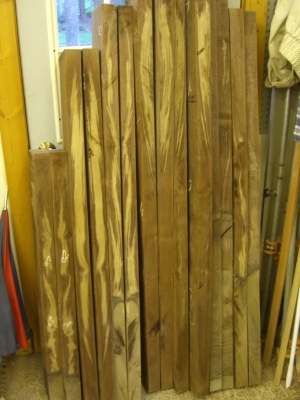
The black walnut - which was interspersed in the same stacks as the claro in the same load - came out uniformly between 6 - 8% MC. After a couple of weeks with varying results, we unloaded the kiln and the customer planed down the claro to find yellow streaks throughout the wood. These streaks corresponded with where there was higher MC%. (See photo - the yellow streaks are not sapwood). Interestingly enough, the yellow wood is buried in the boards; the surface is a uniform brown color. It is only after planing the surface off that the yellow wood is exposed.

The kiln stacks were all measured with an anemometer for proper air flow, and my equipment is working properly. Is this a common problem when drying claro walnut? Are there any special techniques that I should follow in order to successfully dry this wood?
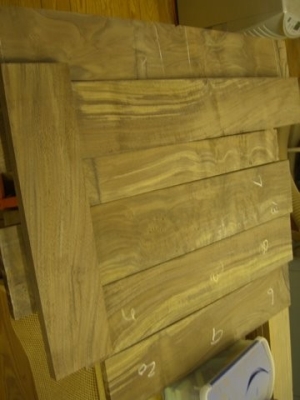
You can see where the yellow streaks are embedded in the wood - primarily in the center of the boards.
Forum Responses
(Sawing and Drying Forum)
From Professor Gene Wengert, forum technical advisor:
If the yellow color is in the heartwood, it will darken with exposure to air and light.

The moisture problem is called a water pocket, wetwood, or bacterial wetwood. The high moisture is more common with thicker stock. The cause is a bacterial infection in the tree. It cannot be fixed, so drying must be very slow. In fact, air drying for 6 months or more is suggested. Avoid sawing 8/4 and thicker from such logs. After drying, it is common to find cracks in this wood, as it is weaker than normal. If you use the wood before it is dried, then the moisture will leave eventually and the wood will shrink at that time.


From the original questioner:
Gene, as always, thanks much for sharing your insight. Any suggestions as to a good targeted daily MC% reduction rate to use considering the bacterial infection in the wood?


From Professor Gene Wengert, forum technical advisor:
As you have noted, the bacterial wood has not dried much at all, so the drying rate is close to zero.


From contributor J:
Would like to know if the bacterial infection can be detected (without much due process) in the green wood. We dry with a kiln other than the Nyle and have the same problem


From Professor Gene Wengert, forum technical advisor:
If the high initial MC or the odor or the shake are not present, then it is difficult to detect ahead of time.
Have you reviewed the related Knowledge Base areas below?
  • KnowledgeBase: Knowledge Base

  • KnowledgeBase: Primary Processing

  • KnowledgeBase: Primary Processing: Air Drying Lumber

  • KnowledgeBase: Primary Processing: Kiln Operation


    Would you like to add information to this article? ... Click Here

    If you have a question regarding a Knowledge Base article, your best chance at uncovering an answer is to search the entire Knowledge Base for related articles or to post your question at the appropriate WOODWEB Forum. Before posting your message, be sure to
    review our Forum Guidelines.

    Questions entered in the Knowledge Base Article comment form will not generate responses! A list of WOODWEB Forums can be found at WOODWEB's Site Map.

    When you post your question at the Forum, be sure to include references to the Knowledge Base article that inspired your question. The more information you provide with your question, the better your chances are of receiving responses.

    Return to beginning of article.


    Refer a Friend || Read This Important Information || Site Map || Privacy Policy

    Letters, questions or comments? E-Mail us and let us know what you think. Be sure to review our Frequently Asked Questions page.

    Contact us to discuss advertising or to report problems with this site.

    To report a problem, send an e-mail to our Webmaster

    Copyright © 1996-2008 - WOODWEB ® Inc.
    All rights reserved. No part of this publication may be reproduced in any manner without permission of the Editor.
    Review WOODWEB's Copyright Policy.

    The editors, writers, and staff at WOODWEB try to promote safe practices. What is safe for one woodworker under certain conditions may not be safe for others in different circumstances. Readers should undertake the use of materials and methods discussed at WOODWEB after considerate evaluation, and at their own risk.

    WOODWEB, Inc.
    RR4 Box 265A
    Montrose, PA 18801

    Contact WOODWEB
