Preventing Tire Damage from Blade Breakage
Here's a discussion about how to spot breaking blades before they snap and damage tires on the mill, along with some controversy about lubrication, sawdust buildup, and the relative advantages of steel wheels versus rubber tires. June 18, 2010
Question
I have had a Turner mill for the last 2 years that I am very happy with, but I ran into a problem. I broke my first blade a month ago, and that was fine, as it had been sharpened a few times, and I understand that they don't last forever. I broke my second one on Friday, as I had just completed a cut and was throttling back the engine. The blade went in behind the wheels and wrapped around the axles, and in the process it made about an 8" slash through the sidewall of the drive tire. $47 later I have a new tire, but I want to prevent this from happening again. Should I be inspecting my blades for cracks? Am I doing something else wrong? I left a phone message for Mr. Turner today, but thought I would see if anyone has advice.
Forum Responses
(Sawing and Drying Forum)
From contributor A:
Who sharpens your blades? Are you running them too long? Are your guides adjusted correctly?
I inspect my blades before and after sharpening. Watching the blade when the engine is slowing down and looking for the blade moving back and forth when running slow is a tall tale sign that the blade is cracked. It will jump forward when crack passes between roller guides, if you have those. Most all blades I have broken are from running them too long and the blade is dull.
I know those of you that like the Turner design think the tires are great, but tires can never be trued and balanced to keep from introducing harmonics into the band blade when running. That is the reason many people are changing to all metal wheels. Both my mills have these wheels and the blades last twice as long as the old belted wheels because of the vibration that B belts add to the blade.
From contributor R:
When a blade goes around the tire, it makes the blade bend and after a while they end up breaking.
The tires are way better than steel wheels. Steel wheels need water on them to keep the blade cool and they break more blades than the tires. The tires can be balanced just like on your car.
From contributor A:
Water is not used for lube. We have had this discussion before, many times. It is used to keep sawdust from sticking to the band wheels and that is the only reason. It is really interesting that many mill owners are changing out belted wheels to all metal. Wonder why this is happening? In a high production setting, rubber tires or belts are very hard on blades. If you have a toy (small) mill, than it does not make much difference. You will never push a mill to cut lumber fast. The only thing that happens is you will break more blades with the rubber tires or belts vs. all steel. These are facts! Your rubber tires can and do have sawdust buildup on them - I have seen pictures of it.
If you ever have to keep the blade cool with water, then your blade is very dull, and should have been changed hours ago. Tires just do not work well! I can sharpen a blade 20 times and it never breaks. I know that would never happen with a rubber tire. How much run out do you get with a rubber tire? 1/8 of an inch. That is standard for a tire. All of my steel band wheels have .003 or less run out. If a rubber tire could be shaved to .015 run out, it would be out of balance.
From the original questioner:
I didn't mean to re-open the tires vs metal wheels can of worms. I am just wondering if there is a way to protect rubber tires from breaking blades. Thank you for explaining how to tell when a blade is cracking. I didn't know that, and it will be helpful. I do have bearing guides, so that should be an easy way to check the blades, as you said. Personally I like my mill, but as you say I am not using it in a production setting.
From contributor R:
I said it was water that keeps the blade cool. The reason sawdust sticks to those steel wheels is because steel on steel builds up heat. But anyway, all saw blades will break over time, from metal fatigue.
The facts are, if tires can run on a car at 200MPH without vibration, same principle works on the Turner bandmill.
Here's my Turner mill (and what you can do with a toy mill.)
Modifications and Tricks with Small Bandsaw Mills
From contributor D:
That's an interesting point about tire run out, contributor A. It got me thinking about what would win out - the strength of the band to smash in that run out versus the mass of the run out? I guess that is a moot point as the stress on the band from smashing it in would in itself be a problem.
To the original questioner: The only protection that comes to mind would be metal cylinders fastened to the inside of the front and back shields that were sized a bit smaller than the outside of the tire and just long enough to nearly touch the tread of the tire. This should keep a broken blade away from the sidewalls, but I don't know how it would affect clearing sawdust, or interfere with guide rollers, etc., on your mill. This problem also comes up on mills that use metal wheels. It ain't pretty when a broken band goes in behind one of them, either.
From contributor T:
To answer the original question, check the gullets of the blade very closely to look for cracks. If the blades broke at the welds, it could simply be bad blades. Make sure your guides are adjusted properly also.
A few years ago after a similar thread, I started keeping track of my blade sharpening. At the time I had a lot of blades that had been sharpened 10-12 times and still no cracks. I have at least 4 blades that have been sharpened way over 25 times and no cracks. It is because of using rubber tires, not belts or steel wheels.
I have yet to have a blade break after 6 years. I have had them bend into an "S" shape, took pliers and straightened them back and put back in use. I never have sawdust buildup on the rubber tires. Maybe the slight flex of them keeps them clean.
From contributor A:
Why would you need to cool a blade? You're cutting wet logs. Truly, cooling the blades is not the reason. I too used water for the first few years until I started cutting very pitchy Douglas fir. All the water in the world did not help. Adding Pinesol did not work either. I could use 5 to 7 gallons of water a day or 5 gallons of diesel in 3 months. I will never use water again! The felt wiper system puts a very small amount of diesel on the inside of the blade just to keep the buildup of sawdust from accumulating. Then the metal wipers scrape off any sawdust that might not come off. That is when I started using diesel fuel with the felt wick system that my mill was designed with.
I also sharpen all my own blades; I wipe the blade with a rag, as I am inspecting it before it gets sharpened. I do get lazy sometimes and do not check the blades before sharpening. I missed a crack last month after sharpening the blade. It has been years since I have broken a blade on the mill while it was cutting. If it has been on the mill cutting and I suspect it could be cracked, I stop the mill and check it, by hand spinning it around to check, looking in the gullet.
This was back when both my mills were all manual. I broke many blades when I started cutting and after a while, I learned what to look for. This was with belted wheels. After I upgraded to power feed and power up and down, I went through the same process again. Finally when I installed the second mill to all metal wheels, I stopped breaking blades. Yes, it does happen from time to time.
The picture I remember was from contributor R himself. There was built up sawdust on the tire in the picture. There is no perfect solution to the buildup of sawdust. Rubber tires may work for some, but every high production mill uses all metal wheels. My local big mill uses a 10 inch by 36 foot band blade. There is no rubber on the band wheels and they do not use any kind of liquid on the blade. This mill produces between 20,000- 50,000 bf a day. Why reinvent the wheel? This is a proven system. The only reason to use tires is they're cheap!
$47.00 for a tire versus $300.00 for an all metal band wheel. This is not rocket science.
Where I am in western Washington, there is so much difference from where most of you hail. Cutting a big, not large, Douglas fir log (44” in diameter; large, to me, is above 50”), I was only able to make 4 passes through the log before changing the blade because it was dull. This was a 26” wide cut and with 3 different but new blades. This was not because the blades were bad, but that some of this stuff is extremely hard and dulls the tips of the blades rapidly. I like the MunkforsSagar blades; two of those were these blades. The third was a Cook’s super sharp blade; it only lasted for 3 passes before being dull. I have done blade tests for most blade manufacturers and the MunkforsSagar and Cooks’ are the best for the price. Cooks’ blades are best for hardwoods and MunkforsSagar are for all the rest. The resaw I have has WM blades and these were a direct copy of MunkforsSagar blades from years ago.
I am very excited to travel from Seattle to Alabama a week from today to visit Cooks’ Saw and Machine. It will be nice to spend the day with the people that built both my mills, and learn more from people that are on the cutting edge of band mill machines. I am reposting the picture of the all metal band wheels.
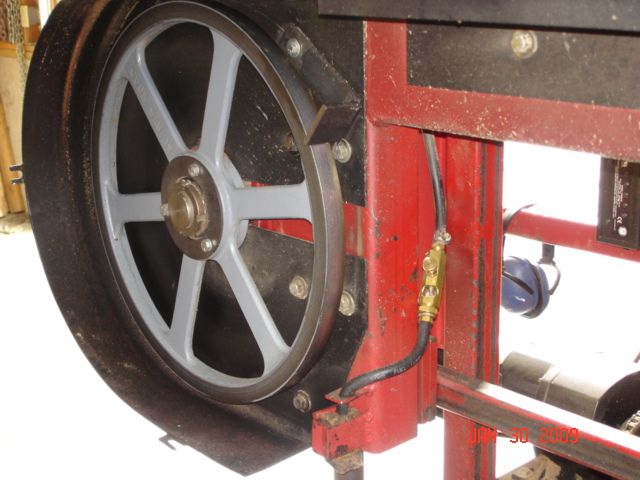
Click here for higher quality, full size image
From contributor P:
The answer to your problem is to learn what the blade does when it becomes cracked. On my mill, the blade will jump forward about 1/4 inch when the crack in the gullet gets about 1/4 inch deep. The crack will be very visible then and easy to find. To avoid tire or belt or face or arm or other damage done by blade breakage, I watch for evidence of cracks, and when they appear, I take the blade off and break it so I don't put it back on by accident.
From contributor S:
I've been running B56 v belts with good luck. Some of my 1-1/4 bands are down to under 1" from sharpening quite a few times. Last spring I put on a really good guard that keeps sawdust and wood chips from getting caught between the guide wheel, drive wheel and the blade, which I think really helped. That said, there's always room for improvement. I've been thinking of steel wheels. Do you run crowned ones or flat ones? To someone running those flat ones: what kind of blade life?
From contributor W:
I am running the metal wheels and they are flat. The only problem I had was that TK said to set tracking 7/16" from back of wheel. That put too much pressure on the back edge of the blade because of the tow in to keep the blade there. I now run it about 1/8" from edge and 800 lb. pressure. No more cracking. I have discussed the crowned wheels with Cook's and will purchase a set when the economy permits. I will also trade up to a Cook's mill as soon as the economy permits. I am getting much better blade life with the steel wheels and smoother lumber due to the lack of vibration from the v belts. I built a lube system for my mill and run the diesel on top and bottom of blade. Contributor A, looks like you are running Cook's wheels?
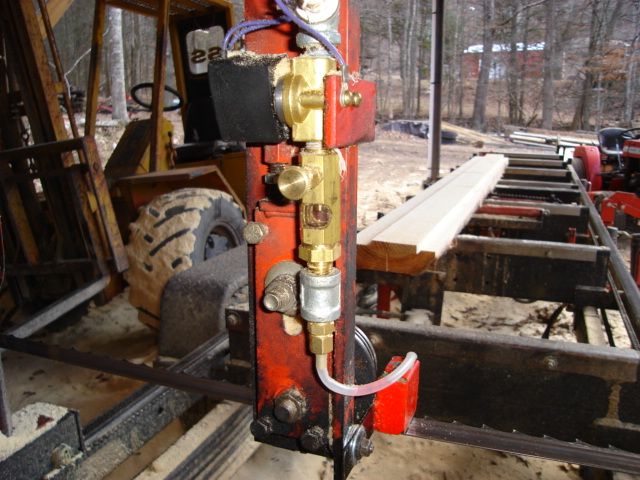
Click here for higher quality, full size image
From contributor R:
The bottom line is, it's no big deal if there is sawdust on the tires. But it must be a big deal with the steel wheels, right? With the tires, the blade tension is no big deal either. You can run the blade with loose or tight tension and it cuts the same. Can you do that with steel wheels? There are a lot less problems with tires than with steel wheels. And they don't cost as much as steel wheels. A broken blade might cut the tire, but I've never heard of a blade cutting the tire so that it wouldn't hold air. And I've never heard of anyone wearing a tire out.
From the original questioner:
Thank you all for your help. It sounds like checking blades for cracks is easier than I had thought. I will do that and hope I can keep from breaking more while running. Contributor R, you said you never heard of a blade cutting a tire badly enough so it wouldn't hold air, but that is what happened to me. The blade made an 8" long slash all the way through the sidewall of the tire, so I had to buy a new one. I seem to have some variation in smoothness of cut from one blade to another, but most of the time my mill cuts smooth enough so that some people think the lumber has already been planed. I am only sawing a few thousand feet per year, so I don't have the kind of pressure that those who saw full time are under.
From contributor R:
Well, you are the first person I've ever heard of that happening to. The easiest way to fix a problem like that would be to use a 10 ply tire. Some of those cheap tires will break the sidewall when you hit a curb going 5 mph. Or maybe you just got a defective tire.
From contributor Y:
I bought 30
Wood-Mizer bands when I got my mill four years ago. So far, after several resharps of each blade, I have broken five blades. I plan on running every blade until
Wood-Mizer Resharp rejects it, or they snap. I think it would be expected to break a blade every once in a while.
From contributor R:
It helps a lot to have the tires balanced like you would on your car.
There is no problem if the sawdust builds up on the tires or guide bearing - it doesn't build up on the blade.
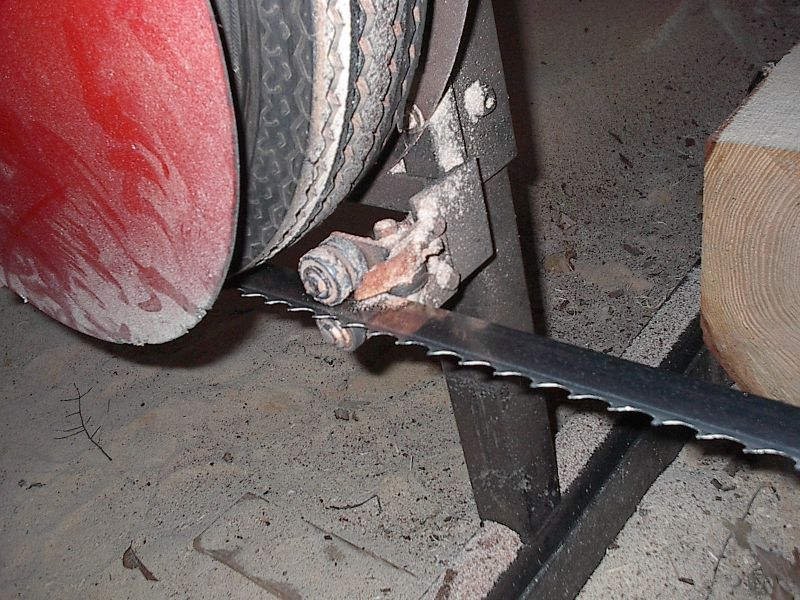
Click here for higher quality, full size image
From contributor W:
Who would want their guide rollers to look like that? What are the repercussions of running a mill in this condition? Notice the cuts in the guard from blade breakage or whatever. I rest my case on using lubrication with the Tturner mill.
From contributor R:
The repercussions of running a mill in this condition are 0. If you think the bearing might wear out faster, that's a no. The bearings at the time were $1.50 each at the local bearing shop. And yes, I've broken blades before.
From the original questioner:
My bearings have gotten to looking like that a couple of times. It is an indication, for me anyway, that I need to adjust the two sets of bearings so that they are tighter together and in better contact with the blade. The repercussions of running my mill with the bearings unadjusted are blade wandering and wavy lumber, so I try to avoid it. I think if I cut a lot of white pine I would want to use some sort of liquid on the blade, but I don't get much buildup so far from hardwoods or hemlock or red pine when I have a sharp blade.
From contributor R:
You're right - they were a little out of adjustment, but I had no problems cutting, so left it alone.
From contributor C:
If you are going to balance the tires on the mill, I highly recommend having them powder/bead balanced. If you happen to get a build up on one side of the tire, the powder/beads will rebalance on the fly. I use this on all my tires (except on a car, where the tires tend to accelerate too fast for it to work).
